How to Pack a Home Aquarium for Moving Without Losing Your Fish or Your Tank
Moving a home aquarium safely means draining the tank, transporting fish properly, and preserving your biological filter. This guide covers every step.
Knowing how to pack a home aquarium for moving is one of those tasks that feels deceptively simple right up until the moment you realize everything that is actually at stake. It is just a glass box full of water, right? Then you look at the 125-gallon display tank that took four people to carry into the house. Then you count the livestock — rare cichlids, a colony of corals, a pair of clownfish you have had for six years. Then you notice the sump system built into the cabinet below, the custom lighting canopy bolted to the rim, the CO2 line running to the planted side, and the canister filter that has not been fully cleaned since last winter. It does not have to go that way.
If you would rather have experienced professionals handle the heavy lifting while you focus on keeping your fish alive and your tank intact, call our team at 719-357-9048 to lock in your move date.
Whether your home aquarium is a fully planted 200-gallon freshwater showpiece with custom cabinetry and a built-in sump, a reef tank loaded with live coral and sensitive invertebrates, or a modest 30-gallon community tank sitting on a stand in your living room — the strategy below will walk you through every category, from your most delicate livestock to the heaviest glass panels, so everything arrives safely, intact, and ready to be re-established in your new home without a single casualty.
Why Packing a Home Aquarium Goes Wrong More Often Than It Should
A home aquarium is one of the most consistently underestimated packing challenges in any household move. The setup looks stable — water is clear, fish are swimming peacefully, equipment is humming along. That calm surface hides a genuinely fragile and time-sensitive system. Every aquarium is a living ecosystem with multiple interdependencies: biological filtration built up over months, water chemistry parameters that took weeks to stabilize, and livestock that are acutely sensitive to temperature swings, oxygen depletion, and ammonia spikes. Disrupt any one of those variables and the consequences cascade quickly.
Three specific patterns cause the majority of home aquarium packing failures:
- Moving the tank with water or substrate still inside — Even a partially filled tank creates enormous, shifting weight that stresses silicone seams and tempered glass in ways the manufacturer never intended. Gravel and sand compress and shift during transport, grinding against the bottom glass panel with every bump in the road. Many people underestimate how quickly a compromised seal can fail, and a tank that holds water perfectly in a stationary home can develop a slow leak — or a catastrophic one — within hours of being moved.
- Inadequate livestock transport planning — Fish, invertebrates, and live coral cannot simply be bagged in tap water and left in a cooler for six hours. Water temperature, dissolved oxygen, ammonia buildup from fish waste, and pH stability all deteriorate rapidly in a sealed transport container. Saltwater livestock is especially unforgiving. Without proper oxygenation, buffering, and temperature control during the move, even healthy fish can be lost well before you reach your new address.
- Disrupting the biological filter without a recovery plan — The beneficial bacteria living in your filter media, substrate, and live rock are the invisible infrastructure of your aquarium. They process ammonia and nitrite around the clock. Rinse your filter media with tap water, let it dry out, or separate it from tank water for too long, and you will crash your cycle and face a toxic tank at the other end of the move. Re-establishing the nitrogen cycle from scratch takes weeks and puts every fish at risk in the meantime.
How to Start: Preparation Begins Days Before Moving Day
The single most important principle when packing a home aquarium for moving is that preparation cannot begin on moving day. Aquarium moves require a staged approach that starts at least three to seven days in advance, depending on the size of your system and the number of livestock you are transporting.
Do a partial water change and collect transport water early
Two to three days before the move, perform a water change and save the old tank water in clean, food-safe buckets with lids. This aged, dechlorinated water — already matched to your tank's chemistry — is far safer for transporting fish than fresh water. For a saltwater system, you will want to mix additional salt water in advance and store it at the correct salinity, ready to top off transport containers and re-fill the tank at your destination.
Stop feeding fish 24 to 48 hours before the move
This is counterintuitive but important. Fish that have been recently fed produce significantly more ammonia in a sealed transport bag or bucket. Fasting your livestock for one to two days before the move reduces waste output and helps keep water quality stable during transport. Healthy fish can easily go 48 hours without food with no harm done.
Gather your livestock transport supplies
You will need thick, double-layered fish transport bags (or dedicated fish buckets with lids and battery-powered air pumps), rubber bands, foam boxes or insulated coolers to maintain temperature, and a net for each species to avoid cross-contamination. For reef tanks, coral frags and sensitive invertebrates may need their own sealed containers with supplemental oxygen if the drive is longer than two hours.
Breaking Down the Tank: The Right Order for Disassembly
Once your livestock transport containers are ready and your fish have been fasted, you can begin breaking down the tank itself. The order of operations matters enormously here — rushing or doing things out of sequence is where most of the damage happens.
Step 1 — Remove and bag your livestock
Net your fish carefully and transfer them into their transport bags or buckets filled with saved tank water. Work methodically — catch the most difficult fish first while the tank is still full, since a nearly empty tank makes netting panicked fish stressful for both of you. Seal bags with an oxygen mix if possible, or run a battery air pump into a covered bucket. Place livestock containers in an insulated cooler to maintain temperature stability.
Step 2 — Remove live rock, decorations, and plants
Live rock should be kept wet in buckets of saved tank water — never allowed to dry out, as the beneficial bacteria and invertebrates living on it will die within minutes in open air. Artificial decorations can be rinsed and packed in boxes. Plastic plants can be bagged or boxed loose. Planted tank substrates with root systems should be transferred to a bucket with enough water to keep roots submerged.
Step 3 — Remove and protect equipment
Unplug and carefully remove the heater, allowing it to cool completely before packing — glass heaters cracked by temperature shock are a common and avoidable loss. Remove the filter, keeping the media submerged in saved tank water inside a sealed bag or bucket. Never rinse filter media in tap water. Disconnect and drain the sump. Remove the lighting canopy, powerheads, protein skimmer, CO2 equipment, and any other ancillary hardware, and pack each component individually in padded boxes.
Step 4 — Drain and handle the empty tank
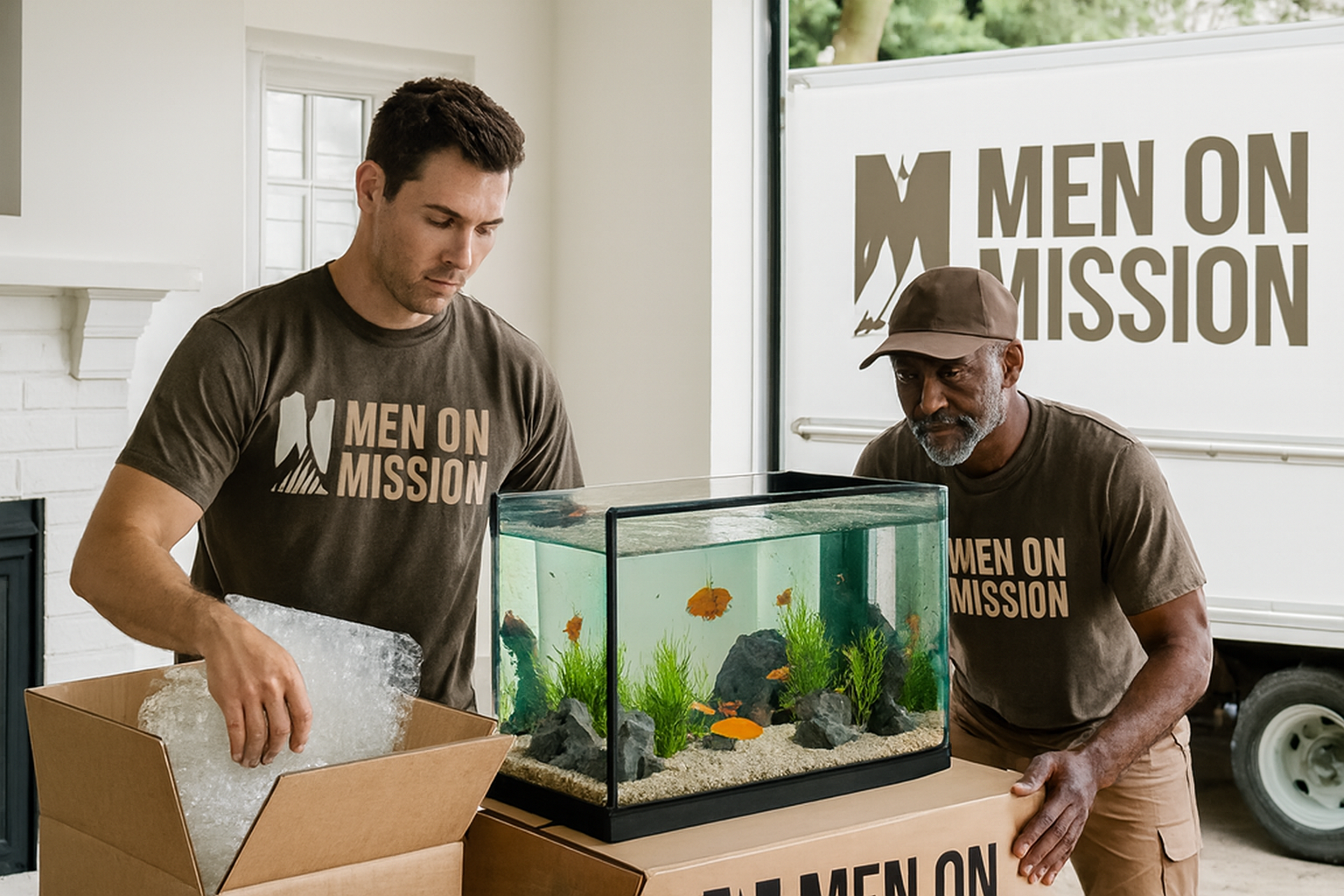
Once all substrate, water, livestock, and equipment are removed, the empty tank is ready to be moved. Even an empty aquarium is heavy, fragile, and requires two or more people to carry safely. Wrap the outside of the glass in moving blankets and do not stack anything on top of the tank during transport. If your tank has a rimless design or frameless glass-to-glass construction, it deserves extra protection — consider custom-cut foam padding along every edge.
Transporting Livestock Safely on the Road
The livestock leg of the move is where the greatest risk concentrates. Fish and invertebrates are not passive cargo — they are consuming oxygen, producing waste, and responding to stress the entire time they are in transport containers.
- Keep transport time under four hours where possible. Beyond four hours in a sealed bag, oxygen levels drop and ammonia accumulates to stressful levels for most fish. If your move is longer, use battery-powered air pumps in open-top buckets with lids rather than sealed bags, which allows continuous oxygenation.
- Maintain temperature within two to three degrees of the tank's normal range. Use insulated coolers and, if necessary, chemical hand warmers or cold packs wrapped in towels to stabilize temperature — never placed directly against a bag or bucket wall.
- Keep livestock containers upright and secured in the vehicle. Transport containers that tip, slide, or jostle stress fish and can dilute oxygen. Pack them snugly in a cooler or crate so they do not shift during the drive.
- Acclimate fish slowly when re-introducing them to the tank. At your destination, float sealed bags in the tank for 15 to 20 minutes before opening to equalize temperature, then add small amounts of new tank water gradually before releasing fish. This reduces osmotic shock significantly.
Re-establishing the Tank at Your New Home
Getting the tank set up quickly at the destination is just as important as how you packed it. The longer your filter media sits without circulation, the more of your beneficial bacterial colony you lose. Aim to have equipment running again within a few hours of arrival.
Rinse the tank interior with clean water, then add your saved substrate, live rock, and decorations. Refill with saved tank water first, topping off with your pre-mixed fresh or salt water. Restart filtration immediately. Once temperature and chemistry are confirmed stable, begin acclimating your livestock back into the tank. For the first week after the move, test water parameters daily — ammonia, nitrite, nitrate, and pH — and perform partial water changes as needed to keep levels safe while the biological cycle re-stabilizes.
Moving an aquarium is genuinely one of the most complex logistics challenges in any home relocation — more so than most people expect until they are standing in front of it with a net in one hand and a moving box in the other. If you are approaching a move and want experienced help managing the heavy, fragile, and high-stakes work involved, our team is ready. Call 719-357-9048 or get a free moving quote and let us handle the hard part.
Frequently Asked Questions
Can I move my fish tank without emptying it?
No — moving an aquarium with water, substrate, or livestock still inside is strongly discouraged. Even partially filled tanks place enormous stress on glass seams and silicone joints that are not designed to flex during transport. The shifting weight of water and gravel during movement can crack the bottom panel or cause seal failures that only become visible after the tank is re-filled. Always fully drain the tank, remove all livestock, and transport the empty glass separately.
How do I transport fish safely during a move?
The safest approach is to transfer fish into doubled fish transport bags filled with saved tank water, then seal the bags with air or oxygen and place them inside an insulated cooler to maintain temperature. For moves longer than two to three hours, use battery-powered air pumps in lidded buckets rather than sealed bags to allow continuous oxygenation. Stop feeding fish 24 to 48 hours before the move to reduce ammonia buildup in the transport water.
How do I keep my biological filter alive during the move?
The key is to keep your filter media submerged in saved tank water the entire time — never rinse it in tap water, never let it dry out, and never expose it to temperatures significantly outside the tank's normal range. Transfer filter sponges, ceramic rings, and bio-media into a sealed bag or bucket of tank water before disassembly, and get filtration running again at your destination as quickly as possible to minimize bacterial loss.
How long can fish survive in transport bags or buckets?
Most healthy freshwater fish can survive four to six hours in a properly sealed bag with adequate oxygen. Saltwater fish and sensitive invertebrates are generally less tolerant and should ideally be transported in under three to four hours. For longer moves, battery-powered air pumps in open-top buckets with lids dramatically extend safe transport time by providing continuous oxygenation. Coral and marine invertebrates may require supplemental oxygen bags for moves exceeding two hours.
Should I hire professional movers to help with my aquarium?
For large or heavy tanks — anything over 55 gallons — professional movers with experience in specialty moving are strongly recommended. An empty 100-gallon aquarium can weigh 200 pounds or more, and moving glass of that size safely requires proper padding, multiple trained handlers, and equipment like furniture dollies and moving blankets. Professionals can also transport the empty tank securely in a padded truck environment that minimizes vibration and impact risk during transit.
Knowing how to pack a home aquarium for moving is one of those tasks that feels deceptively simple right up until the moment you realize everything that is actually at stake. It is just a glass box full of water, right? Then you look at the 125-gallon display tank that took four people to carry into the house. Then you count the livestock — rare cichlids, a colony of corals, a pair of clownfish you have had for six years. Then you notice the sump system built into the cabinet below, the custom lighting canopy bolted to the rim, the CO2 line running to the planted side, and the canister filter that has not been fully cleaned since last winter. It does not have to go that way.
If you would rather have experienced professionals handle the heavy lifting while you focus on keeping your fish alive and your tank intact, call our team at 719-357-9048 to lock in your move date.
Whether your home aquarium is a fully planted 200-gallon freshwater showpiece with custom cabinetry and a built-in sump, a reef tank loaded with live coral and sensitive invertebrates, or a modest 30-gallon community tank sitting on a stand in your living room — the strategy below will walk you through every category, from your most delicate livestock to the heaviest glass panels, so everything arrives safely, intact, and ready to be re-established in your new home without a single casualty.
Why Packing a Home Aquarium Goes Wrong More Often Than It Should
A home aquarium is one of the most consistently underestimated packing challenges in any household move. The setup looks stable — water is clear, fish are swimming peacefully, equipment is humming along. That calm surface hides a genuinely fragile and time-sensitive system. Every aquarium is a living ecosystem with multiple interdependencies: biological filtration built up over months, water chemistry parameters that took weeks to stabilize, and livestock that are acutely sensitive to temperature swings, oxygen depletion, and ammonia spikes. Disrupt any one of those variables and the consequences cascade quickly.
Three specific patterns cause the majority of home aquarium packing failures:
- Moving the tank with water or substrate still inside — Even a partially filled tank creates enormous, shifting weight that stresses silicone seams and tempered glass in ways the manufacturer never intended. Gravel and sand compress and shift during transport, grinding against the bottom glass panel with every bump in the road. Many people underestimate how quickly a compromised seal can fail, and a tank that holds water perfectly in a stationary home can develop a slow leak — or a catastrophic one — within hours of being moved.
- Inadequate livestock transport planning — Fish, invertebrates, and live coral cannot simply be bagged in tap water and left in a cooler for six hours. Water temperature, dissolved oxygen, ammonia buildup from fish waste, and pH stability all deteriorate rapidly in a sealed transport container. Saltwater livestock is especially unforgiving. Without proper oxygenation, buffering, and temperature control during the move, even healthy fish can be lost well before you reach your new address.
- Disrupting the biological filter without a recovery plan — The beneficial bacteria living in your filter media, substrate, and live rock are the invisible infrastructure of your aquarium. They process ammonia and nitrite around the clock. Rinse your filter media with tap water, let it dry out, or separate it from tank water for too long, and you will crash your cycle and face a toxic tank at the other end of the move. Re-establishing the nitrogen cycle from scratch takes weeks and puts every fish at risk in the meantime.
How to Start: Preparation Begins Days Before Moving Day
The single most important principle when packing a home aquarium for moving is that preparation cannot begin on moving day. Aquarium moves require a staged approach that starts at least three to seven days in advance, depending on the size of your system and the number of livestock you are transporting.
Do a partial water change and collect transport water early
Two to three days before the move, perform a water change and save the old tank water in clean, food-safe buckets with lids. This aged, dechlorinated water — already matched to your tank's chemistry — is far safer for transporting fish than fresh water. For a saltwater system, you will want to mix additional salt water in advance and store it at the correct salinity, ready to top off transport containers and re-fill the tank at your destination.
Stop feeding fish 24 to 48 hours before the move
This is counterintuitive but important. Fish that have been recently fed produce significantly more ammonia in a sealed transport bag or bucket. Fasting your livestock for one to two days before the move reduces waste output and helps keep water quality stable during transport. Healthy fish can easily go 48 hours without food with no harm done.
Gather your livestock transport supplies
You will need thick, double-layered fish transport bags (or dedicated fish buckets with lids and battery-powered air pumps), rubber bands, foam boxes or insulated coolers to maintain temperature, and a net for each species to avoid cross-contamination. For reef tanks, coral frags and sensitive invertebrates may need their own sealed containers with supplemental oxygen if the drive is longer than two hours.
Breaking Down the Tank: The Right Order for Disassembly
Once your livestock transport containers are ready and your fish have been fasted, you can begin breaking down the tank itself. The order of operations matters enormously here — rushing or doing things out of sequence is where most of the damage happens.
Step 1 — Remove and bag your livestock
Net your fish carefully and transfer them into their transport bags or buckets filled with saved tank water. Work methodically — catch the most difficult fish first while the tank is still full, since a nearly empty tank makes netting panicked fish stressful for both of you. Seal bags with an oxygen mix if possible, or run a battery air pump into a covered bucket. Place livestock containers in an insulated cooler to maintain temperature stability.
Step 2 — Remove live rock, decorations, and plants
Live rock should be kept wet in buckets of saved tank water — never allowed to dry out, as the beneficial bacteria and invertebrates living on it will die within minutes in open air. Artificial decorations can be rinsed and packed in boxes. Plastic plants can be bagged or boxed loose. Planted tank substrates with root systems should be transferred to a bucket with enough water to keep roots submerged.
Step 3 — Remove and protect equipment
Unplug and carefully remove the heater, allowing it to cool completely before packing — glass heaters cracked by temperature shock are a common and avoidable loss. Remove the filter, keeping the media submerged in saved tank water inside a sealed bag or bucket. Never rinse filter media in tap water. Disconnect and drain the sump. Remove the lighting canopy, powerheads, protein skimmer, CO2 equipment, and any other ancillary hardware, and pack each component individually in padded boxes.
Step 4 — Drain and handle the empty tank
Once all substrate, water, livestock, and equipment are removed, the empty tank is ready to be moved. Even an empty aquarium is heavy, fragile, and requires two or more people to carry safely. Wrap the outside of the glass in moving blankets and do not stack anything on top of the tank during transport. If your tank has a rimless design or frameless glass-to-glass construction, it deserves extra protection — consider custom-cut foam padding along every edge.
Transporting Livestock Safely on the Road
The livestock leg of the move is where the greatest risk concentrates. Fish and invertebrates are not passive cargo — they are consuming oxygen, producing waste, and responding to stress the entire time they are in transport containers.
- Keep transport time under four hours where possible. Beyond four hours in a sealed bag, oxygen levels drop and ammonia accumulates to stressful levels for most fish. If your move is longer, use battery-powered air pumps in open-top buckets with lids rather than sealed bags, which allows continuous oxygenation.
- Maintain temperature within two to three degrees of the tank's normal range. Use insulated coolers and, if necessary, chemical hand warmers or cold packs wrapped in towels to stabilize temperature — never placed directly against a bag or bucket wall.
- Keep livestock containers upright and secured in the vehicle. Transport containers that tip, slide, or jostle stress fish and can dilute oxygen. Pack them snugly in a cooler or crate so they do not shift during the drive.
- Acclimate fish slowly when re-introducing them to the tank. At your destination, float sealed bags in the tank for 15 to 20 minutes before opening to equalize temperature, then add small amounts of new tank water gradually before releasing fish. This reduces osmotic shock significantly.
Re-establishing the Tank at Your New Home
Getting the tank set up quickly at the destination is just as important as how you packed it. The longer your filter media sits without circulation, the more of your beneficial bacterial colony you lose. Aim to have equipment running again within a few hours of arrival.
Rinse the tank interior with clean water, then add your saved substrate, live rock, and decorations. Refill with saved tank water first, topping off with your pre-mixed fresh or salt water. Restart filtration immediately. Once temperature and chemistry are confirmed stable, begin acclimating your livestock back into the tank. For the first week after the move, test water parameters daily — ammonia, nitrite, nitrate, and pH — and perform partial water changes as needed to keep levels safe while the biological cycle re-stabilizes.
Moving an aquarium is genuinely one of the most complex logistics challenges in any home relocation — more so than most people expect until they are standing in front of it with a net in one hand and a moving box in the other. If you are approaching a move and want experienced help managing the heavy, fragile, and high-stakes work involved, our team is ready. Call 719-357-9048 or get a free moving quote and let us handle the hard part.
Have Questions About Your Move?

Can I move my fish tank without emptying it?
No — moving an aquarium with water, substrate, or livestock still inside is strongly discouraged. Even partially filled tanks place enormous stress on glass seams and silicone joints that are not designed to flex during transport. The shifting weight of water and gravel during movement can crack the bottom panel or cause seal failures that only become visible after the tank is re-filled. Always fully drain the tank, remove all livestock, and transport the empty glass separately.
How do I transport fish safely during a move?
The safest approach is to transfer fish into doubled fish transport bags filled with saved tank water, then seal the bags with air or oxygen and place them inside an insulated cooler to maintain temperature. For moves longer than two to three hours, use battery-powered air pumps in lidded buckets rather than sealed bags to allow continuous oxygenation. Stop feeding fish 24 to 48 hours before the move to reduce ammonia buildup in the transport water.
How do I keep my biological filter alive during the move?
The key is to keep your filter media submerged in saved tank water the entire time — never rinse it in tap water, never let it dry out, and never expose it to temperatures significantly outside the tank's normal range. Transfer filter sponges, ceramic rings, and bio-media into a sealed bag or bucket of tank water before disassembly, and get filtration running again at your destination as quickly as possible to minimize bacterial loss.
How long can fish survive in transport bags or buckets?
Most healthy freshwater fish can survive four to six hours in a properly sealed bag with adequate oxygen. Saltwater fish and sensitive invertebrates are generally less tolerant and should ideally be transported in under three to four hours. For longer moves, battery-powered air pumps in open-top buckets with lids dramatically extend safe transport time by providing continuous oxygenation. Coral and marine invertebrates may require supplemental oxygen bags for moves exceeding two hours.
Should I hire professional movers to help with my aquarium?
For large or heavy tanks — anything over 55 gallons — professional movers with experience in specialty moving are strongly recommended. An empty 100-gallon aquarium can weigh 200 pounds or more, and moving glass of that size safely requires proper padding, multiple trained handlers, and equipment like furniture dollies and moving blankets. Professionals can also transport the empty tank securely in a padded truck environment that minimizes vibration and impact risk during transit.