Packing a Home Library Without Damaging Rare Books
Pack a home library for moving without damage or disorder. Step-by-step guide on box sizes, orientation, rare books, and preserving your collection.
Knowing how to pack a home library for moving is one of those tasks that looks completely manageable until the moment you actually start. Books are just books, right? Then you count the shelves. Then you realize you have somewhere between three hundred and a thousand volumes, a collection built over years that includes oversized art books, fragile paperback spines that have already been repaired once, hardcovers with dust jackets worth protecting, and a handful of signed editions sitting quietly on the top shelf that you would never forgive yourself for damaging in transit. It does not have to go that way.
If you would rather have experienced professionals handle the heavy lifting while you focus on keeping your household running, call our team at 719-357-9048 to lock in your move date.
Whether your home library is a dedicated reading room lined floor to ceiling with built-in shelves, a sprawling living room wall of books sorted by genre and author, or a collection spread across bookcases in three different rooms — the strategy below will walk you through every category, from your heaviest reference volumes to your most delicate rare editions, so everything arrives safely, organized, and ready to find its place on new shelves.
Why Packing a Home Library Goes Wrong More Often Than It Should
A home library is one of the most consistently underestimated packing challenges in any household move. Books feel straightforward — they are rectangular, they stack, they do not break the way glass does. That perception is exactly what causes problems. Books are deceptively heavy, spine damage is permanent, and a disorganized collection that took years to build can take months of frustrating work to reassemble if it is not packed with a plan.
Three specific patterns cause the majority of home library packing failures:
- Using boxes that are too large — It is instinctive to grab the biggest box available and fill it with books. The result is a box that weighs sixty or seventy pounds, is nearly impossible to carry safely, and puts the books at the bottom under enormous pressure. Spines crack. Pages buckle. And the movers — or your own back — pay the price.
- Packing without preserving any organizational system — Most people pack books in whatever order they come off the shelf, mixing genres, authors, and series indiscriminately. When they arrive at the new home, the entire collection has to be resorted from scratch. If you built a system that worked — alphabetical, by genre, by reading priority — losing it costs far more time than it saved to ignore it.
- Treating all books identically — A mass-market paperback and a signed first edition are not the same packing problem. Neither are a standard hardcover and a large-format coffee table book. When every book goes into a box the same way, the most valuable and most fragile pieces absorb the same handling risk as the most expendable ones.
The solution is to approach your library the way a bookseller or archivist would: with categories, appropriate box sizes, and a clear system that survives the move intact. It takes more time upfront, but it saves an enormous amount of time and frustration on the other end.
What You Need Before You Start Packing Books
Gathering the right materials before you open a single box will make the difference between a packing session that goes smoothly and one that stalls every twenty minutes because you are missing something.
The Right Boxes
Small boxes — typically in the range of 1.5 to 2 cubic feet — are the correct choice for books. This is not a suggestion. It is the single most important physical decision you will make when packing a library. A small box filled with books is still heavy but remains manageable. A medium or large box filled with books becomes a liability. Use small boxes consistently and do not be tempted to overfill them.
If your collection includes large-format art books, photography books, or oversized reference volumes, set those aside. They will need their own approach and often travel better laid flat in a medium box, interleaved with packing paper, rather than packed spine-to-spine with standard volumes.
Packing Materials
- Packing paper (unprinted newsprint) — For wrapping dust jackets, padding between rows, and protecting covers. Avoid newspaper, which can transfer ink to pages and covers.
- Bubble wrap — Reserved for signed editions, rare books, and anything with a fragile binding or loose pages.
- Packing tape — Reinforce box bottoms before loading. Books are dense; an unreinforced bottom will fail under the weight.
- Markers and labels — You will want to label every box not just by room but by category or shelf section. This is the step that makes unpacking manageable.
- A notebook or phone — For documenting the contents and order of each box, especially if you are preserving a sorting system.
How to Pack Standard Books Correctly
The mechanics of packing books well are straightforward once you know the rules — and breaking them is what leads to damaged spines and warped covers.
Orientation Matters
There are three ways to orient a book in a box: spine down, spine up, or lying flat. Each has a correct application:
- Spine down — This is the worst position for most books. The pages splay, the binding is stressed by the weight of the pages themselves, and damage accumulates over a long move.
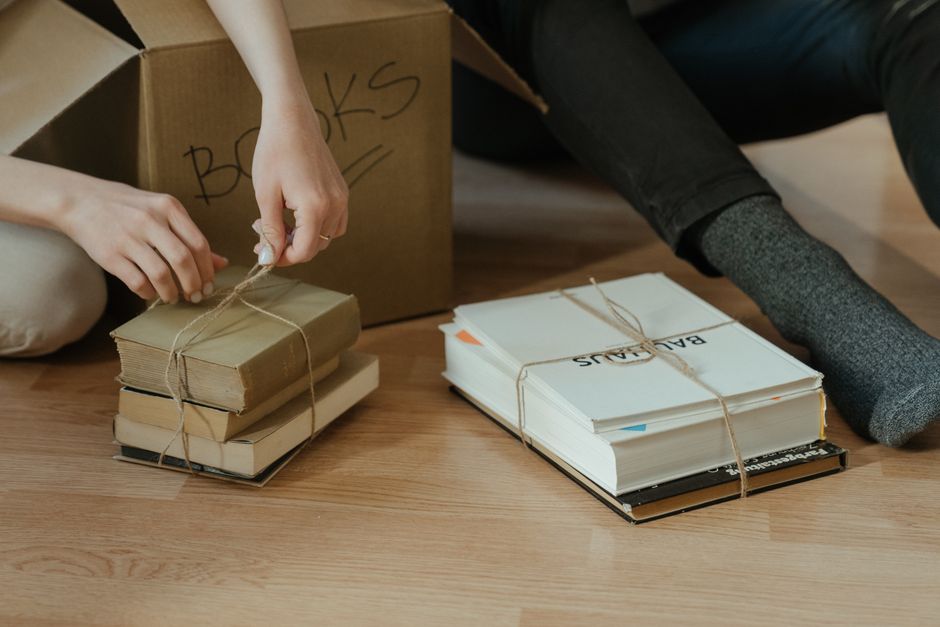
- Standing upright (spine against the side of the box) — This is the correct position for most standard hardcovers and paperbacks. Pack them as you would on a shelf, snugly but not compressed. Fill any gaps at the end of a row with crumpled packing paper so books cannot shift and fall over during transit.
- Lying flat — The correct position for oversized books, art books, and any volume too tall to stand upright in a small box. Stack flat books largest to smallest, with packing paper between each one.
Weight Distribution
When filling a box, place heavier hardcovers at the bottom and lighter paperbacks on top. Never place heavy books on top of paperbacks — the spines and covers of the paperbacks will absorb the weight and emerge from the box with permanent creasing.
Once a box is full, fill any remaining space with crumpled packing paper before sealing. A half-empty box allows books to shift, which means they arrive having spent the trip banging against each other and the walls of the box.
How to Handle Rare, Signed, and Fragile Books
Rare books, signed editions, first editions, and any volume with significant monetary or sentimental value deserve a different level of care than the general collection. Set these aside first, before you begin the main packing process, so they are not accidentally swept into a general box.
Individual Wrapping
Each rare or fragile book should be wrapped individually in packing paper, with extra attention to the dust jacket if one is present. Dust jackets are often more valuable than the book itself for collectible editions — do not let them slide off during packing. Wrap the jacket around the book and secure it with a loose wrap of packing paper before wrapping the whole volume.
For extremely fragile bindings — older books where the spine is already weak, books with loose pages, or any volume that you would handle with care even at home — wrap in a layer of packing paper, then a layer of bubble wrap, then paper again. This creates cushioning without allowing the bubble wrap to press directly on a delicate surface for an extended period.
Dedicated Boxes for Valuables
Do not mix rare or signed books with the general collection in the same box. Pack them separately, label the box clearly, and consider transporting it personally rather than in the moving truck if the value — financial or sentimental — justifies the precaution.
Photograph Before You Pack
Take photos of your rarest books before packing, including close-ups of any distinguishing features, inscriptions, or condition details. If damage occurs during the move, documentation is essential for any insurance or replacement conversation.
Preserving Your Organizational System Through the Move
If your collection has an organizational structure that matters to you — alphabetical by author, sorted by genre, arranged by the order you want to re-read them — the time to protect that system is before you pack a single box, not after you arrive at the new home with forty unlabeled boxes of books.
Label by Section, Not Just by Room
Standard moving labels that say "Library" or "Books" are nearly useless when unpacking a large collection. Label each box with the shelf section it came from: "Fiction A–F," "Travel and Geography," "Reference — Bottom Shelf," "Children's Books." The more specific your labels, the faster your new shelves take shape.
Pack Shelf by Shelf
Rather than pulling books from multiple shelves at once, work one shelf at a time, packing from left to right in the order the books appear. Number your boxes sequentially within each section. When you arrive, you can unpack box one of a section before box two, and your books land back on the shelves in their original order without any re-sorting.
Take a Photo of Each Shelf Before You Pack It
A thirty-second photograph of each shelf before you clear it gives you a reference image if anything is unclear during unpacking. This is especially useful for collections organized in ways that are intuitive to you but might not be obvious from a label alone.
Packing Bookshelves and Furniture
Once the books are out, the shelving itself needs to be prepared for the move. Empty bookshelves are awkward but not especially heavy — the challenge is protecting shelves and uprights from scratching and dinging during loading and transit.
- Remove all adjustable shelves and pack them together, wrapped in moving blankets or packing paper, and secured with tape. Label them so you know which unit they belong to.
- Wrap uprights and the main body of freestanding bookcases in moving blankets before loading.
- Built-in shelving that is being left behind should be cleaned and patched if any hardware was removed.
- If bookcases are being disassembled entirely, keep all hardware — screws, shelf pins, brackets — in a labeled zip-lock bag taped to the piece.
The Final Check Before the Truck Leaves
Before closing up any box, do a final visual check: no books standing spine-down, no empty space that would allow shifting, no heavy hardcovers resting directly on paperbacks. Every box bottom should be double-taped. Every box should be labeled on at least two sides so the label is visible regardless of how it is stacked.
Walk through the room one last time after everything is boxed. Check under chairs and tables for stray volumes, look behind the door, and check any surface where a book might have been set down and forgotten. Dedicated readers almost always find at least one book they nearly left behind.
A well-packed library arrives in the same order it left — and getting your books back onto shelves in a new home, in the right order, with nothing missing or damaged, is one of the most satisfying parts of settling in.
Frequently Asked Questions
What size boxes should I use when packing books for a move?
Small boxes — typically 1.5 to 2 cubic feet — are the correct choice for books. Books are dense and heavy, and filling a larger box makes it nearly impossible to carry safely. Small boxes keep each load manageable and reduce the risk of box failure during loading and transport.
How should I orient books inside a moving box?
Most books should stand upright with the spine against the side of the box, the same way they sit on a shelf. Oversized and large-format books should lie flat, stacked largest to smallest with packing paper between each one. Avoid standing books spine-down, which stresses the binding and causes pages to splay.
How do I protect rare or signed books during a move?
Wrap each rare or signed book individually in packing paper, with extra care around any dust jacket. For fragile bindings, add a layer of bubble wrap between two layers of packing paper. Pack valuable books in their own dedicated box, label it clearly, and consider transporting it personally rather than in the moving truck.
How do I keep my book collection organized through a move?
Label each box by shelf section rather than just 'books' — for example, 'Fiction A–F' or 'Travel and Geography.' Pack one shelf at a time, left to right, and photograph each shelf before you clear it. Number boxes sequentially within each section so they can be unpacked in order and your collection lands back on the shelves correctly.
Should I disassemble my bookshelves before the movers arrive?
Yes. Remove all adjustable shelves and pack them together wrapped in packing paper or moving blankets, labeled to match the unit they belong to. Wrap freestanding bookcases in moving blankets before loading. If disassembling completely, keep all hardware in a labeled bag taped to the piece so nothing is lost in transit.
Knowing how to pack a home library for moving is one of those tasks that looks completely manageable until the moment you actually start. Books are just books, right? Then you count the shelves. Then you realize you have somewhere between three hundred and a thousand volumes, a collection built over years that includes oversized art books, fragile paperback spines that have already been repaired once, hardcovers with dust jackets worth protecting, and a handful of signed editions sitting quietly on the top shelf that you would never forgive yourself for damaging in transit. It does not have to go that way.
If you would rather have experienced professionals handle the heavy lifting while you focus on keeping your household running, call our team at 719-357-9048 to lock in your move date.
Whether your home library is a dedicated reading room lined floor to ceiling with built-in shelves, a sprawling living room wall of books sorted by genre and author, or a collection spread across bookcases in three different rooms — the strategy below will walk you through every category, from your heaviest reference volumes to your most delicate rare editions, so everything arrives safely, organized, and ready to find its place on new shelves.
Why Packing a Home Library Goes Wrong More Often Than It Should
A home library is one of the most consistently underestimated packing challenges in any household move. Books feel straightforward — they are rectangular, they stack, they do not break the way glass does. That perception is exactly what causes problems. Books are deceptively heavy, spine damage is permanent, and a disorganized collection that took years to build can take months of frustrating work to reassemble if it is not packed with a plan.
Three specific patterns cause the majority of home library packing failures:
- Using boxes that are too large — It is instinctive to grab the biggest box available and fill it with books. The result is a box that weighs sixty or seventy pounds, is nearly impossible to carry safely, and puts the books at the bottom under enormous pressure. Spines crack. Pages buckle. And the movers — or your own back — pay the price.
- Packing without preserving any organizational system — Most people pack books in whatever order they come off the shelf, mixing genres, authors, and series indiscriminately. When they arrive at the new home, the entire collection has to be resorted from scratch. If you built a system that worked — alphabetical, by genre, by reading priority — losing it costs far more time than it saved to ignore it.
- Treating all books identically — A mass-market paperback and a signed first edition are not the same packing problem. Neither are a standard hardcover and a large-format coffee table book. When every book goes into a box the same way, the most valuable and most fragile pieces absorb the same handling risk as the most expendable ones.
The solution is to approach your library the way a bookseller or archivist would: with categories, appropriate box sizes, and a clear system that survives the move intact. It takes more time upfront, but it saves an enormous amount of time and frustration on the other end.
What You Need Before You Start Packing Books
Gathering the right materials before you open a single box will make the difference between a packing session that goes smoothly and one that stalls every twenty minutes because you are missing something.
The Right Boxes
Small boxes — typically in the range of 1.5 to 2 cubic feet — are the correct choice for books. This is not a suggestion. It is the single most important physical decision you will make when packing a library. A small box filled with books is still heavy but remains manageable. A medium or large box filled with books becomes a liability. Use small boxes consistently and do not be tempted to overfill them.
If your collection includes large-format art books, photography books, or oversized reference volumes, set those aside. They will need their own approach and often travel better laid flat in a medium box, interleaved with packing paper, rather than packed spine-to-spine with standard volumes.
Packing Materials
- Packing paper (unprinted newsprint) — For wrapping dust jackets, padding between rows, and protecting covers. Avoid newspaper, which can transfer ink to pages and covers.
- Bubble wrap — Reserved for signed editions, rare books, and anything with a fragile binding or loose pages.
- Packing tape — Reinforce box bottoms before loading. Books are dense; an unreinforced bottom will fail under the weight.
- Markers and labels — You will want to label every box not just by room but by category or shelf section. This is the step that makes unpacking manageable.
- A notebook or phone — For documenting the contents and order of each box, especially if you are preserving a sorting system.
How to Pack Standard Books Correctly
The mechanics of packing books well are straightforward once you know the rules — and breaking them is what leads to damaged spines and warped covers.
Orientation Matters
There are three ways to orient a book in a box: spine down, spine up, or lying flat. Each has a correct application:
- Spine down — This is the worst position for most books. The pages splay, the binding is stressed by the weight of the pages themselves, and damage accumulates over a long move.
- Standing upright (spine against the side of the box) — This is the correct position for most standard hardcovers and paperbacks. Pack them as you would on a shelf, snugly but not compressed. Fill any gaps at the end of a row with crumpled packing paper so books cannot shift and fall over during transit.
- Lying flat — The correct position for oversized books, art books, and any volume too tall to stand upright in a small box. Stack flat books largest to smallest, with packing paper between each one.
Weight Distribution
When filling a box, place heavier hardcovers at the bottom and lighter paperbacks on top. Never place heavy books on top of paperbacks — the spines and covers of the paperbacks will absorb the weight and emerge from the box with permanent creasing.
Once a box is full, fill any remaining space with crumpled packing paper before sealing. A half-empty box allows books to shift, which means they arrive having spent the trip banging against each other and the walls of the box.
How to Handle Rare, Signed, and Fragile Books
Rare books, signed editions, first editions, and any volume with significant monetary or sentimental value deserve a different level of care than the general collection. Set these aside first, before you begin the main packing process, so they are not accidentally swept into a general box.
Individual Wrapping
Each rare or fragile book should be wrapped individually in packing paper, with extra attention to the dust jacket if one is present. Dust jackets are often more valuable than the book itself for collectible editions — do not let them slide off during packing. Wrap the jacket around the book and secure it with a loose wrap of packing paper before wrapping the whole volume.
For extremely fragile bindings — older books where the spine is already weak, books with loose pages, or any volume that you would handle with care even at home — wrap in a layer of packing paper, then a layer of bubble wrap, then paper again. This creates cushioning without allowing the bubble wrap to press directly on a delicate surface for an extended period.
Dedicated Boxes for Valuables
Do not mix rare or signed books with the general collection in the same box. Pack them separately, label the box clearly, and consider transporting it personally rather than in the moving truck if the value — financial or sentimental — justifies the precaution.
Photograph Before You Pack
Take photos of your rarest books before packing, including close-ups of any distinguishing features, inscriptions, or condition details. If damage occurs during the move, documentation is essential for any insurance or replacement conversation.
Preserving Your Organizational System Through the Move
If your collection has an organizational structure that matters to you — alphabetical by author, sorted by genre, arranged by the order you want to re-read them — the time to protect that system is before you pack a single box, not after you arrive at the new home with forty unlabeled boxes of books.
Label by Section, Not Just by Room
Standard moving labels that say "Library" or "Books" are nearly useless when unpacking a large collection. Label each box with the shelf section it came from: "Fiction A–F," "Travel and Geography," "Reference — Bottom Shelf," "Children's Books." The more specific your labels, the faster your new shelves take shape.
Pack Shelf by Shelf
Rather than pulling books from multiple shelves at once, work one shelf at a time, packing from left to right in the order the books appear. Number your boxes sequentially within each section. When you arrive, you can unpack box one of a section before box two, and your books land back on the shelves in their original order without any re-sorting.
Take a Photo of Each Shelf Before You Pack It
A thirty-second photograph of each shelf before you clear it gives you a reference image if anything is unclear during unpacking. This is especially useful for collections organized in ways that are intuitive to you but might not be obvious from a label alone.
Packing Bookshelves and Furniture
Once the books are out, the shelving itself needs to be prepared for the move. Empty bookshelves are awkward but not especially heavy — the challenge is protecting shelves and uprights from scratching and dinging during loading and transit.
- Remove all adjustable shelves and pack them together, wrapped in moving blankets or packing paper, and secured with tape. Label them so you know which unit they belong to.
- Wrap uprights and the main body of freestanding bookcases in moving blankets before loading.
- Built-in shelving that is being left behind should be cleaned and patched if any hardware was removed.
- If bookcases are being disassembled entirely, keep all hardware — screws, shelf pins, brackets — in a labeled zip-lock bag taped to the piece.
The Final Check Before the Truck Leaves
Before closing up any box, do a final visual check: no books standing spine-down, no empty space that would allow shifting, no heavy hardcovers resting directly on paperbacks. Every box bottom should be double-taped. Every box should be labeled on at least two sides so the label is visible regardless of how it is stacked.
Walk through the room one last time after everything is boxed. Check under chairs and tables for stray volumes, look behind the door, and check any surface where a book might have been set down and forgotten. Dedicated readers almost always find at least one book they nearly left behind.
A well-packed library arrives in the same order it left — and getting your books back onto shelves in a new home, in the right order, with nothing missing or damaged, is one of the most satisfying parts of settling in.
Have Questions About Your Move?
What size boxes should I use when packing books for a move?
Small boxes — typically 1.5 to 2 cubic feet — are the correct choice for books. Books are dense and heavy, and filling a larger box makes it nearly impossible to carry safely. Small boxes keep each load manageable and reduce the risk of box failure during loading and transport.
How should I orient books inside a moving box?
Most books should stand upright with the spine against the side of the box, the same way they sit on a shelf. Oversized and large-format books should lie flat, stacked largest to smallest with packing paper between each one. Avoid standing books spine-down, which stresses the binding and causes pages to splay.
How do I protect rare or signed books during a move?
Wrap each rare or signed book individually in packing paper, with extra care around any dust jacket. For fragile bindings, add a layer of bubble wrap between two layers of packing paper. Pack valuable books in their own dedicated box, label it clearly, and consider transporting it personally rather than in the moving truck.
How do I keep my book collection organized through a move?
Label each box by shelf section rather than just 'books' — for example, 'Fiction A–F' or 'Travel and Geography.' Pack one shelf at a time, left to right, and photograph each shelf before you clear it. Number boxes sequentially within each section so they can be unpacked in order and your collection lands back on the shelves correctly.
Should I disassemble my bookshelves before the movers arrive?
Yes. Remove all adjustable shelves and pack them together wrapped in packing paper or moving blankets, labeled to match the unit they belong to. Wrap freestanding bookcases in moving blankets before loading. If disassembling completely, keep all hardware in a labeled bag taped to the piece so nothing is lost in transit.