How to Pack a Living Room for Moving Without Losing a Week of Your Life
Packing a living room takes more planning than most expect. This guide covers electronics, artwork, furniture, and décor so nothing arrives broken or lost.
Knowing how to pack a living room for moving is deceptively difficult — and treating it as a straightforward job is one of the fastest ways to blow your moving day schedule. Living rooms look like open space, but they are dense with fragile décor, tangled electronics, oversized furniture, and years of accumulated belongings wedged into shelves, drawers, and cabinets. None of it packs itself, and none of it forgives careless handling. It does not have to go that way.
If you would rather have experienced professionals handle the heavy lifting while you focus on the details, call our team at 719-357-9048 to lock in your move date.
Whether you are packing a sprawling open-plan living space or a compact apartment sitting room, the strategy below will walk you through every category — from the flat-screen on the wall to the throw pillows on the couch — so nothing arrives cracked, scratched, or mysteriously missing on the other end.
Why Packing a Living Room Is Harder Than It Looks
The living room is usually one of the first rooms people attempt to pack and one of the last they actually finish. It contains more distinct categories of belongings than almost any other room in the house: electronics with cables that go missing, artwork that needs special wrapping, furniture too large to move without disassembly, books that fill box after box, and decorative items that are fragile in ways that only become obvious after something breaks.
Three specific patterns cause most living room packing failures:
- Underestimating volume — a living room that feels open and airy when you live in it can produce a surprising number of packed boxes. Shelving units, media consoles, and coffee table drawers quietly hold far more than they appear to.
- Skipping the electronics plan — televisions, gaming systems, speakers, and streaming devices each have their own cables, remotes, and mounting hardware. Packing them without a system produces a tangled mess that takes hours to sort out at the new place.
- Treating furniture as a moving-day decision — sofas, entertainment centers, and bookcases often cannot leave a room without some disassembly. Discovering this when the movers arrive wastes time and risks damage to both the furniture and the doorframe.
The fix is a phased plan that works backward from moving day, prioritizing the categories you need least and leaving only the things you use daily for the very last push.
Phase One: Declutter and Sort Before a Single Box Opens
The single most valuable thing you can do before packing a living room is reduce what you actually need to move. A living room that has been lived in for a few years accumulates books you have already read, DVDs that no longer play on anything you own, decorative items that you have stopped noticing, and furniture you kept "just in case." Moving all of it to a new home means finding space for all of it in a new home.
Books and Media
Pull every book off the shelves before you pack a single one. Sort them into what you genuinely plan to re-read or reference, what you want to keep for display or sentiment, and what you have simply been storing. That third pile — the one you would not notice missing — is your donation stack. Books are among the heaviest items per box in any move, and reducing your book count before packing has an immediate impact on your total number of boxes and your total moving weight.
The same logic applies to DVDs, Blu-rays, video games, and CDs. Physical media collections have a way of persisting long after the devices to play them have been replaced. A realistic audit before moving day saves boxes, weight, and shelf space at the other end.
Decorative Items and Accessories
Go through every shelf, side table, and display surface. Decorative objects that you have not consciously noticed in the past year are strong candidates for donation or sale. The goal is not minimalism — it is intentionality. Every item you choose to keep should have a clear place in the new home before it goes into a box.
Phase Two: Pack by Category, Not by Location
Once you have decluttered, begin packing in category order rather than simply working from one end of the room to the other. Category packing keeps related items together, makes labeling meaningful, and prevents the common problem of opening fifteen boxes to find one cable.
Electronics: The Category That Rewards a System
Electronics are the most logistically demanding category in any living room pack. Before disconnecting anything, photograph the back of your television and every device connected to your entertainment system. A quick photo takes ten seconds and eliminates the guesswork of reconnection at the new address.
Use a labeling system for cables. A strip of masking tape labeled with a marker works perfectly — wrap it around the cable near the plug and write what it connects. Cable ties or zip ties keep bundles neat. Each device's cables should stay with that device, either bundled inside the box or taped to the outside in a labeled bag.
For televisions, the original box is ideal. If you no longer have it, a flat-screen TV box (available at most moving supply stores) provides purpose-built protection. Never lay a flat-screen television on its face or back during transit — transport it upright. Use moving blankets around the screen and place it in the truck where it will not shift.
Remote controls, power strips, and small accessories go in clearly labeled bags, then into clearly labeled boxes. "Electronics — Living Room — Remotes and Cables" is a label worth writing. "Misc" is not.
Books and Heavy Items
Books go in small boxes — always. A large box of books will be too heavy for most people to safely lift and can exceed the structural limit of the box itself. Small boxes filled two-thirds with books, topped with lighter items like throw blankets or linens, pack efficiently and stay manageable. Stand books on their spines to protect the binding during transit.
Artwork and Framed Items
Framed artwork needs individual wrapping. Use packing paper, bubble wrap, or furniture pads to wrap each piece separately. For glass-fronted frames, an X of painter's tape across the glass before wrapping adds a layer of protection — if the glass does crack in transit, the tape holds the shards in place rather than allowing them to damage the art or the person unpacking it.
Flat, framed pieces transport best standing upright in the truck, not stacked flat. If you have several framed pieces, a mirror box or picture box (which telescopes to fit various sizes) is worth the investment for any piece that matters to you.
Soft Furnishings
Throw pillows, blankets, and light textiles are useful packing material as much as they are items to be moved. Use them to pad empty space in boxes containing fragile items. Large blankets and comforters compress well in vacuum storage bags, which significantly reduce the volume they occupy. Pillows go into large garbage bags or wardrobe boxes as filler around other items.
Phase Three: Plan for the Furniture
Living room furniture presents the most logistical complexity of any room. Sofas, sectionals, entertainment centers, and large bookcases all require a plan before moving day — not a decision made in the hallway while two people are already holding a sofa at an awkward angle.
Measure Before Moving Day
Measure every large piece of furniture and compare it against doorway widths, stairwell dimensions, and hallway turns in both the current home and the destination. This is not optional — a sofa that fit through one set of doors may not fit through another, and discovering this during the move costs time, energy, and sometimes causes real damage. If a piece will not fit, know that before the truck arrives so you can plan accordingly (disassemble it, arrange for a window removal, or make a separate decision about the piece).
Disassemble What You Can
Most entertainment centers and shelving units disassemble into flat panels that move far more easily than the assembled unit. Sectional sofas typically separate at the joining brackets, turning a near-immovable piece into two manageable sections. Take photos before disassembly so you know how it goes back together. Place all hardware (screws, bolts, brackets) in a labeled zip-lock bag and tape it to the piece it belongs to.
Protect Upholstery and Wood Surfaces
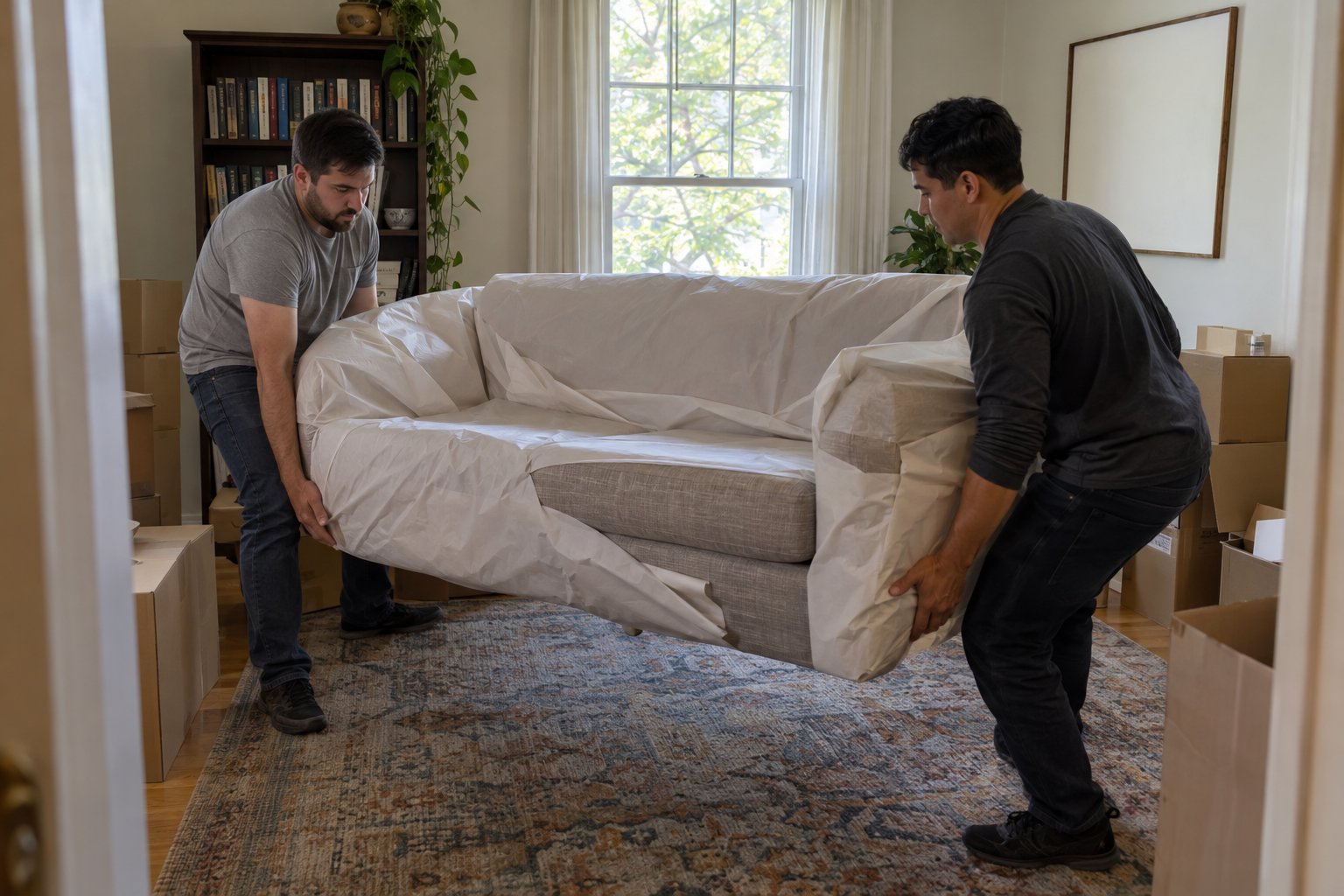
Sofa legs are vulnerable during moves — they catch on doorframes and can snap under impact. Remove legs wherever possible before the move. For sofas that cannot be disassembled, use furniture wrap or moving blankets secured with stretch wrap to protect fabric and exposed wood. Moving blankets over wood tables and cabinets prevent the surface scratches that show up after every unprotected move.
The Final Day: What to Leave Until Last
Even in a thoroughly packed living room, a few things belong in the last-day category: the remote control for whatever you watched the night before, the phone charger on the side table, the reading lamp you use every evening, and the rug underneath everything else. Keep these accessible and pack them as a dedicated "last out, first in" group so they are easy to locate and set up immediately at the new place.
Label every living room box on both the top and at least one side. Boxes stacked in a truck or a new room are almost always read from the side, not the top. A box labeled only on top might as well be unlabeled once it is in a stack. Include both the contents and the destination room so movers — whether professionals or helpful friends — can place each box in the right location without asking.
Packing a living room well is not complicated, but it does require working through the right categories in the right order with the right materials. Do that, and you will arrive at your new home with a living room that can be up and running the same evening — rather than still half-assembled a week later.
Frequently Asked Questions
How far in advance should I start packing my living room?
Most people can begin packing the living room seven to ten days before the move. Start with items you use least — books, decorative objects, rarely used media — and work toward the things you use daily. Leave only the absolute essentials (a lamp, a phone charger, the television if you are still using it) for the final day or two.
What is the best way to pack a flat-screen television without the original box?
If you no longer have the original box, a purpose-built flat-screen TV moving box is your best option — these are available at most moving supply retailers and telescope to fit a range of screen sizes. Wrap the screen in bubble wrap or a moving blanket first, place the TV upright in the box (never flat), and mark the box clearly as fragile. Transport it upright in the truck as well, where it will not shift.
How do I keep track of all my TV cables and electronics connections during a move?
Before disconnecting anything, photograph the back of your television and every connected device. This gives you a reference image for reconnection. Then label each cable with a strip of masking tape and a marker as you remove it — note what device it connects and which port it uses. Bundle each device's cables together and pack them with that device or in a labeled bag taped to the outside of the device's box.
Should I move my sofa myself or hire professional movers?
If your sofa is large, heavy, or needs to travel through tight doorways or stairwells, professional movers are strongly worth considering. The risk of injury from lifting a heavy sofa incorrectly, combined with the potential for damage to your home or the sofa itself, makes it one of the higher-stakes items in a living room move. If you do move it yourself, measure doorways in advance, remove the legs if possible, wrap the upholstery, and never attempt to carry it without at least one other person.
How should I pack framed artwork and wall decorations?
Wrap each framed piece individually in packing paper or bubble wrap. For glass-fronted frames, apply an X of painter's tape across the glass before wrapping — this holds the glass together if it cracks during transit. Transport framed pieces upright (not flat) in the truck, ideally in mirror or picture boxes sized to fit. Avoid stacking frames directly on top of each other without padding between them.
Knowing how to pack a living room for moving is deceptively difficult — and treating it as a straightforward job is one of the fastest ways to blow your moving day schedule. Living rooms look like open space, but they are dense with fragile décor, tangled electronics, oversized furniture, and years of accumulated belongings wedged into shelves, drawers, and cabinets. None of it packs itself, and none of it forgives careless handling. It does not have to go that way.
If you would rather have experienced professionals handle the heavy lifting while you focus on the details, call our team at 719-357-9048 to lock in your move date.
Whether you are packing a sprawling open-plan living space or a compact apartment sitting room, the strategy below will walk you through every category — from the flat-screen on the wall to the throw pillows on the couch — so nothing arrives cracked, scratched, or mysteriously missing on the other end.
Why Packing a Living Room Is Harder Than It Looks
The living room is usually one of the first rooms people attempt to pack and one of the last they actually finish. It contains more distinct categories of belongings than almost any other room in the house: electronics with cables that go missing, artwork that needs special wrapping, furniture too large to move without disassembly, books that fill box after box, and decorative items that are fragile in ways that only become obvious after something breaks.
Three specific patterns cause most living room packing failures:
- Underestimating volume — a living room that feels open and airy when you live in it can produce a surprising number of packed boxes. Shelving units, media consoles, and coffee table drawers quietly hold far more than they appear to.
- Skipping the electronics plan — televisions, gaming systems, speakers, and streaming devices each have their own cables, remotes, and mounting hardware. Packing them without a system produces a tangled mess that takes hours to sort out at the new place.
- Treating furniture as a moving-day decision — sofas, entertainment centers, and bookcases often cannot leave a room without some disassembly. Discovering this when the movers arrive wastes time and risks damage to both the furniture and the doorframe.
The fix is a phased plan that works backward from moving day, prioritizing the categories you need least and leaving only the things you use daily for the very last push.
Phase One: Declutter and Sort Before a Single Box Opens
The single most valuable thing you can do before packing a living room is reduce what you actually need to move. A living room that has been lived in for a few years accumulates books you have already read, DVDs that no longer play on anything you own, decorative items that you have stopped noticing, and furniture you kept "just in case." Moving all of it to a new home means finding space for all of it in a new home.
Books and Media
Pull every book off the shelves before you pack a single one. Sort them into what you genuinely plan to re-read or reference, what you want to keep for display or sentiment, and what you have simply been storing. That third pile — the one you would not notice missing — is your donation stack. Books are among the heaviest items per box in any move, and reducing your book count before packing has an immediate impact on your total number of boxes and your total moving weight.
The same logic applies to DVDs, Blu-rays, video games, and CDs. Physical media collections have a way of persisting long after the devices to play them have been replaced. A realistic audit before moving day saves boxes, weight, and shelf space at the other end.
Decorative Items and Accessories
Go through every shelf, side table, and display surface. Decorative objects that you have not consciously noticed in the past year are strong candidates for donation or sale. The goal is not minimalism — it is intentionality. Every item you choose to keep should have a clear place in the new home before it goes into a box.
Phase Two: Pack by Category, Not by Location
Once you have decluttered, begin packing in category order rather than simply working from one end of the room to the other. Category packing keeps related items together, makes labeling meaningful, and prevents the common problem of opening fifteen boxes to find one cable.
Electronics: The Category That Rewards a System
Electronics are the most logistically demanding category in any living room pack. Before disconnecting anything, photograph the back of your television and every device connected to your entertainment system. A quick photo takes ten seconds and eliminates the guesswork of reconnection at the new address.
Use a labeling system for cables. A strip of masking tape labeled with a marker works perfectly — wrap it around the cable near the plug and write what it connects. Cable ties or zip ties keep bundles neat. Each device's cables should stay with that device, either bundled inside the box or taped to the outside in a labeled bag.
For televisions, the original box is ideal. If you no longer have it, a flat-screen TV box (available at most moving supply stores) provides purpose-built protection. Never lay a flat-screen television on its face or back during transit — transport it upright. Use moving blankets around the screen and place it in the truck where it will not shift.
Remote controls, power strips, and small accessories go in clearly labeled bags, then into clearly labeled boxes. "Electronics — Living Room — Remotes and Cables" is a label worth writing. "Misc" is not.
Books and Heavy Items
Books go in small boxes — always. A large box of books will be too heavy for most people to safely lift and can exceed the structural limit of the box itself. Small boxes filled two-thirds with books, topped with lighter items like throw blankets or linens, pack efficiently and stay manageable. Stand books on their spines to protect the binding during transit.
Artwork and Framed Items
Framed artwork needs individual wrapping. Use packing paper, bubble wrap, or furniture pads to wrap each piece separately. For glass-fronted frames, an X of painter's tape across the glass before wrapping adds a layer of protection — if the glass does crack in transit, the tape holds the shards in place rather than allowing them to damage the art or the person unpacking it.
Flat, framed pieces transport best standing upright in the truck, not stacked flat. If you have several framed pieces, a mirror box or picture box (which telescopes to fit various sizes) is worth the investment for any piece that matters to you.
Soft Furnishings
Throw pillows, blankets, and light textiles are useful packing material as much as they are items to be moved. Use them to pad empty space in boxes containing fragile items. Large blankets and comforters compress well in vacuum storage bags, which significantly reduce the volume they occupy. Pillows go into large garbage bags or wardrobe boxes as filler around other items.
Phase Three: Plan for the Furniture
Living room furniture presents the most logistical complexity of any room. Sofas, sectionals, entertainment centers, and large bookcases all require a plan before moving day — not a decision made in the hallway while two people are already holding a sofa at an awkward angle.
Measure Before Moving Day
Measure every large piece of furniture and compare it against doorway widths, stairwell dimensions, and hallway turns in both the current home and the destination. This is not optional — a sofa that fit through one set of doors may not fit through another, and discovering this during the move costs time, energy, and sometimes causes real damage. If a piece will not fit, know that before the truck arrives so you can plan accordingly (disassemble it, arrange for a window removal, or make a separate decision about the piece).
Disassemble What You Can
Most entertainment centers and shelving units disassemble into flat panels that move far more easily than the assembled unit. Sectional sofas typically separate at the joining brackets, turning a near-immovable piece into two manageable sections. Take photos before disassembly so you know how it goes back together. Place all hardware (screws, bolts, brackets) in a labeled zip-lock bag and tape it to the piece it belongs to.
Protect Upholstery and Wood Surfaces
Sofa legs are vulnerable during moves — they catch on doorframes and can snap under impact. Remove legs wherever possible before the move. For sofas that cannot be disassembled, use furniture wrap or moving blankets secured with stretch wrap to protect fabric and exposed wood. Moving blankets over wood tables and cabinets prevent the surface scratches that show up after every unprotected move.
The Final Day: What to Leave Until Last
Even in a thoroughly packed living room, a few things belong in the last-day category: the remote control for whatever you watched the night before, the phone charger on the side table, the reading lamp you use every evening, and the rug underneath everything else. Keep these accessible and pack them as a dedicated "last out, first in" group so they are easy to locate and set up immediately at the new place.
Label every living room box on both the top and at least one side. Boxes stacked in a truck or a new room are almost always read from the side, not the top. A box labeled only on top might as well be unlabeled once it is in a stack. Include both the contents and the destination room so movers — whether professionals or helpful friends — can place each box in the right location without asking.
Packing a living room well is not complicated, but it does require working through the right categories in the right order with the right materials. Do that, and you will arrive at your new home with a living room that can be up and running the same evening — rather than still half-assembled a week later.
Have Questions About Your Move?
How far in advance should I start packing my living room?
Most people can begin packing the living room seven to ten days before the move. Start with items you use least — books, decorative objects, rarely used media — and work toward the things you use daily. Leave only the absolute essentials (a lamp, a phone charger, the television if you are still using it) for the final day or two.
What is the best way to pack a flat-screen television without the original box?
If you no longer have the original box, a purpose-built flat-screen TV moving box is your best option — these are available at most moving supply retailers and telescope to fit a range of screen sizes. Wrap the screen in bubble wrap or a moving blanket first, place the TV upright in the box (never flat), and mark the box clearly as fragile. Transport it upright in the truck as well, where it will not shift.
How do I keep track of all my TV cables and electronics connections during a move?
Before disconnecting anything, photograph the back of your television and every connected device. This gives you a reference image for reconnection. Then label each cable with a strip of masking tape and a marker as you remove it — note what device it connects and which port it uses. Bundle each device's cables together and pack them with that device or in a labeled bag taped to the outside of the device's box.
Should I move my sofa myself or hire professional movers?
If your sofa is large, heavy, or needs to travel through tight doorways or stairwells, professional movers are strongly worth considering. The risk of injury from lifting a heavy sofa incorrectly, combined with the potential for damage to your home or the sofa itself, makes it one of the higher-stakes items in a living room move. If you do move it yourself, measure doorways in advance, remove the legs if possible, wrap the upholstery, and never attempt to carry it without at least one other person.
How should I pack framed artwork and wall decorations?
Wrap each framed piece individually in packing paper or bubble wrap. For glass-fronted frames, apply an X of painter's tape across the glass before wrapping — this holds the glass together if it cracks during transit. Transport framed pieces upright (not flat) in the truck, ideally in mirror or picture boxes sized to fit. Avoid stacking frames directly on top of each other without padding between them.