How to Pack Fragile Items for Moving Without Breaking Them
Pack fragile items safely with the right materials and techniques. This guide covers dishes, glassware, art, and electronics so nothing arrives broken.
Knowing how to pack fragile items for moving is one of the most important skills you can develop before a relocation. A single careless moment with a wine glass, a framed painting, or a ceramic heirloom can result in permanent loss — and no amount of bubble wrap applied after the fact will fix a shattered keepsake. Packing breakables correctly takes a little more time upfront, but it virtually eliminates the heartbreak of opening a box to find something irreplaceable in pieces.
If you would rather have experienced professionals handle your fragile belongings from start to finish, call our team at 719-357-9048 to lock in your move date.
Whether you are moving across Colorado Springs or shipping your belongings to another state entirely, the techniques below apply to any household move. Work through each category of fragile item systematically and you will load the truck with genuine confidence that everything inside is protected.
Why Fragile Items Fail During a Move (And What Actually Prevents It)
Most breakage during a move is not caused by rough handling alone. It is caused by a combination of factors that compound each other: inadequate cushioning, boxes that are too large for the weight of their contents, items that shift freely inside their packaging, and stacking heavy boxes on top of light ones. Understanding the root causes makes it much easier to pack defensively.
The three principles that prevent almost all fragile-item damage are:
- Immobilization — every fragile item should be packed so tightly in its cushioning that it cannot move at all inside the box.
- Shock absorption — there must be enough soft material surrounding each item to absorb the energy from bumps, drops, and vibration without transmitting that force to the item itself.
- Weight separation — fragile boxes must never have heavier boxes stacked on top of them, and heavy items must never share a box with light, breakable ones.
Keep these three principles in mind as you work through every fragile category below.
Gather the Right Packing Supplies First
Trying to pack breakables without proper materials is the single biggest mistake people make. Newspaper can work in a pinch for some items, but the ink transfers and it offers less cushioning than purpose-made materials. Before you start, gather the following:
- Bubble wrap — the workhorse of fragile packing; use it as the primary wrap on glassware, ceramics, and electronics
- Packing paper (unprinted newsprint) — ideal for a first layer around dishes and for crumpling into box corners as filler
- Foam pouches or foam sheets — excellent for stemware and small collectibles that need soft, form-fitting protection
- Packing peanuts or air pillows — effective void filler that keeps items centered inside a box
- Small, medium, and dish-specific boxes — smaller boxes are safer for fragile items because they are lighter and easier to control
- Heavy-duty packing tape — seal all seams generously; a box that opens under weight causes damage
- Permanent markers — for marking boxes FRAGILE on all sides and on top
How to Pack Specific Categories of Fragile Items
Dishes and Plates
Plates are deceptively heavy and surprisingly brittle. The safest way to pack them is vertically — standing on their edge like records in a crate — rather than stacked flat. Plates stacked horizontally put pressure on each other and concentrate force on the widest, thinnest surface area.
Here is the process step by step:
- Place two to three inches of crumpled packing paper at the bottom of a small or medium box as a base layer.
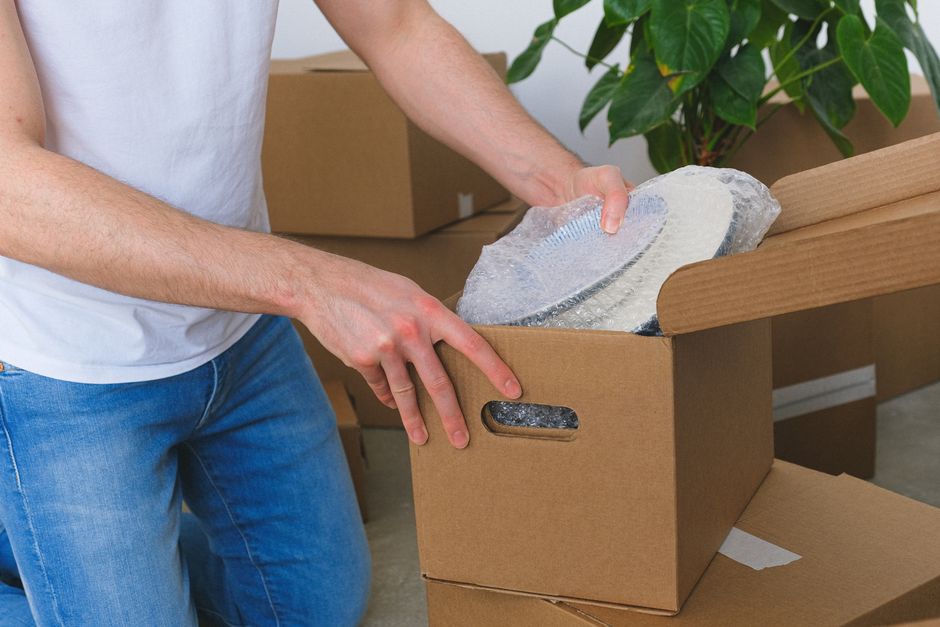
- Wrap each plate individually in at least two sheets of packing paper, folding the corners over the face and tucking them securely.
- For extra protection, add a sheet of bubble wrap around each wrapped plate.
- Stand the wrapped plates on their edges inside the box, packed snugly side by side. They should not wobble or lean.
- Fill any remaining space with crumpled paper so nothing shifts during transit.
- Add a final two-inch layer of paper on top before sealing.
Bowls can be nested inside one another with a sheet of packing paper between each one, then wrapped as a bundle in bubble wrap and packed upright the same way as plates.
Glassware and Stemware
Wine glasses and other stemware are among the most difficult fragile items to protect because the stem is a natural weak point that can snap under very little lateral force. The goal is to immobilize the stem entirely.
- Stuff the inside of each glass with a tight bundle of packing paper or a foam insert. This prevents the glass from imploding inward if compressed.
- Lay the glass on a corner of a large sheet of bubble wrap and roll it diagonally, tucking the ends in as you go.
- Place wrapped glasses upright in a cell-divided box designed for glassware, or create cell dividers from cardboard strips if using a standard box.
- Never lay stemware on its side — pack it upright with the base down.
- Heavier glass items go on the bottom of the box; lighter, more delicate pieces go on top.
- Fill all voids with packing peanuts or crumpled paper before sealing.
Framed Art and Mirrors
Framed artwork and mirrors require their own dedicated boxes — typically mirror boxes or picture boxes, which telescope to fit a range of sizes. Never pack art inside a general household box with other items.
- Apply painter's tape or masking tape in an X pattern across the glass face of the frame. If the glass breaks during transit, the tape holds the shards together rather than letting them scatter and damage the image beneath.
- Wrap the entire frame in a layer of foam sheets or bubble wrap, paying extra attention to the corners where most impact damage occurs.
- Slide the wrapped piece into a picture box and fill any gaps with crumpled paper. The piece should not shift at all when you gently shake the box.
- Seal all seams with heavy tape and mark the box FRAGILE and THIS SIDE UP on every panel.
When loading, stand framed pieces on their long edge — never flat — and lean them against the truck wall rather than stacking anything on top.
Lamps and Lamp Shades
Lamp bases and shades require separate boxes. Lamp shades are particularly vulnerable because their shape makes them nearly impossible to pad with standard materials without distorting the shade itself.
- Lamp bases — wrap the base in bubble wrap and pack it upright in a box with crumpled paper filling all space around it. Remove the bulb before packing.
- Lamp shades — pack shades in a box just large enough to hold them, with the shade resting on its widest rim. Stuff the inside of the shade with loosely crumpled paper (not too tight or it will warp the shape). Do not stack anything inside the shade box.
Electronics and Small Appliances
Whenever possible, use the original manufacturer's box for electronics — it was engineered specifically for that item's dimensions and weight distribution. If the original box is gone, use a box that is only slightly larger than the item itself and fill every gap with foam or air pillows.
- Remove batteries from all devices before packing to prevent corrosion.
- Coil cables neatly and secure them with twist ties; pack cables in labeled zip-lock bags placed inside the same box as the device they belong to.
- Wrap screens in anti-static bubble wrap (the pink variety) rather than standard bubble wrap to avoid static buildup on sensitive components.
- Mark all electronics boxes FRAGILE, HEAVY if applicable, and THIS SIDE UP.
How to Label and Load Fragile Boxes Correctly
Even perfectly packed boxes can be damaged if they are labeled poorly or loaded incorrectly. Labeling is not just about identifying contents — it is a communication tool that tells every person who touches that box exactly how it needs to be handled.
Labeling Best Practices
- Write FRAGILE in large letters on all four sides and the top of the box — not just the top, since boxes are often grabbed from the side.
- Add THIS SIDE UP with an arrow on all four vertical panels whenever the orientation matters (stemware, art, electronics).
- Note the destination room and a brief content description on the top and at least one side panel.
- Consider using colored tape — one color per room — for faster sorting at the new home.
Loading Fragile Boxes in the Truck
- Load heavy furniture and appliances first; fragile boxes always go in last and come out first.
- Place fragile boxes on top of stable, flat surfaces — never on top of soft items like mattresses or cushions that can shift.
- Never stack non-fragile boxes on top of boxes marked FRAGILE.
- If possible, wedge fragile boxes between upholstered furniture pieces that act as natural shock absorbers.
- Use ratchet straps to keep the load stable, but do not run straps directly over fragile boxes — route them around.
When to Let the Professionals Pack Your Fragile Items
Some items are simply too valuable, too large, or too structurally complex to pack safely without professional experience. If you have any of the following, seriously consider hiring professional packers rather than attempting a DIY approach:
- Antique furniture with delicate inlay or veneer surfaces
- Large oil paintings or original artwork
- Grandfather clocks or other mechanical heirlooms
- Sculptures or heavy ceramics on pedestals
- Flat-screen televisions larger than 55 inches
- Pianos or other large musical instruments
Professional movers carry specialized materials — custom crating, foam-in-place packaging, climate-controlled transport — that are not available at a hardware store. The cost of professional packing for high-value items is almost always less than the cost of replacing or restoring them after damage.
If you are ready to hand off the stress of packing your most valuable belongings to a team that handles fragile moves every day, call Men on Mission at 719-357-9048 or request a free quote online. We serve Colorado Springs and the surrounding region, and we treat every item in your home as if it were our own.
Frequently Asked Questions
What is the best material to wrap fragile items for moving?
Bubble wrap is generally the most effective single material for wrapping fragile items because it provides both cushioning and immobilization. For dishes and ceramics, unprinted packing paper works well as a first layer before bubble wrap. Foam pouches or foam sheets are ideal for stemware and delicate collectibles. Avoid using regular newspaper as a primary wrap — the ink transfers onto surfaces and it offers less shock absorption than purpose-made materials.
Should plates be packed flat or on their edge?
Plates should always be packed standing on their edge, like records in a crate, rather than stacked flat. When plates are stacked horizontally, the weight of the stack concentrates force on the widest, thinnest part of each plate, which is exactly where breakage happens. Standing them vertically distributes any impact force along the stronger edge of the plate and dramatically reduces breakage during transit.
How many layers of bubble wrap do fragile items need?
For most household fragile items — dishes, glassware, ceramics, and small decorative objects — two full layers of bubble wrap provide reliable protection. Very delicate items like thin-stemmed wine glasses, antique figurines, or anything with protruding details may benefit from three layers, with extra wrap concentrated around the most vulnerable points such as stems, handles, and corners. The goal is that the item cannot contact the box wall even if the box is compressed slightly.
Knowing how to pack fragile items for moving is one of the most important skills you can develop before a relocation. A single careless moment with a wine glass, a framed painting, or a ceramic heirloom can result in permanent loss — and no amount of bubble wrap applied after the fact will fix a shattered keepsake. Packing breakables correctly takes a little more time upfront, but it virtually eliminates the heartbreak of opening a box to find something irreplaceable in pieces.
If you would rather have experienced professionals handle your fragile belongings from start to finish, call our team at 719-357-9048 to lock in your move date.
Whether you are moving across Colorado Springs or shipping your belongings to another state entirely, the techniques below apply to any household move. Work through each category of fragile item systematically and you will load the truck with genuine confidence that everything inside is protected.
Why Fragile Items Fail During a Move (And What Actually Prevents It)
Most breakage during a move is not caused by rough handling alone. It is caused by a combination of factors that compound each other: inadequate cushioning, boxes that are too large for the weight of their contents, items that shift freely inside their packaging, and stacking heavy boxes on top of light ones. Understanding the root causes makes it much easier to pack defensively.
The three principles that prevent almost all fragile-item damage are:
- Immobilization — every fragile item should be packed so tightly in its cushioning that it cannot move at all inside the box.
- Shock absorption — there must be enough soft material surrounding each item to absorb the energy from bumps, drops, and vibration without transmitting that force to the item itself.
- Weight separation — fragile boxes must never have heavier boxes stacked on top of them, and heavy items must never share a box with light, breakable ones.
Keep these three principles in mind as you work through every fragile category below.
Gather the Right Packing Supplies First
Trying to pack breakables without proper materials is the single biggest mistake people make. Newspaper can work in a pinch for some items, but the ink transfers and it offers less cushioning than purpose-made materials. Before you start, gather the following:
- Bubble wrap — the workhorse of fragile packing; use it as the primary wrap on glassware, ceramics, and electronics
- Packing paper (unprinted newsprint) — ideal for a first layer around dishes and for crumpling into box corners as filler
- Foam pouches or foam sheets — excellent for stemware and small collectibles that need soft, form-fitting protection
- Packing peanuts or air pillows — effective void filler that keeps items centered inside a box
- Small, medium, and dish-specific boxes — smaller boxes are safer for fragile items because they are lighter and easier to control
- Heavy-duty packing tape — seal all seams generously; a box that opens under weight causes damage
- Permanent markers — for marking boxes FRAGILE on all sides and on top
How to Pack Specific Categories of Fragile Items
Dishes and Plates
Plates are deceptively heavy and surprisingly brittle. The safest way to pack them is vertically — standing on their edge like records in a crate — rather than stacked flat. Plates stacked horizontally put pressure on each other and concentrate force on the widest, thinnest surface area.
Here is the process step by step:
- Place two to three inches of crumpled packing paper at the bottom of a small or medium box as a base layer.
- Wrap each plate individually in at least two sheets of packing paper, folding the corners over the face and tucking them securely.
- For extra protection, add a sheet of bubble wrap around each wrapped plate.
- Stand the wrapped plates on their edges inside the box, packed snugly side by side. They should not wobble or lean.
- Fill any remaining space with crumpled paper so nothing shifts during transit.
- Add a final two-inch layer of paper on top before sealing.
Bowls can be nested inside one another with a sheet of packing paper between each one, then wrapped as a bundle in bubble wrap and packed upright the same way as plates.
Glassware and Stemware
Wine glasses and other stemware are among the most difficult fragile items to protect because the stem is a natural weak point that can snap under very little lateral force. The goal is to immobilize the stem entirely.
- Stuff the inside of each glass with a tight bundle of packing paper or a foam insert. This prevents the glass from imploding inward if compressed.
- Lay the glass on a corner of a large sheet of bubble wrap and roll it diagonally, tucking the ends in as you go.
- Place wrapped glasses upright in a cell-divided box designed for glassware, or create cell dividers from cardboard strips if using a standard box.
- Never lay stemware on its side — pack it upright with the base down.
- Heavier glass items go on the bottom of the box; lighter, more delicate pieces go on top.
- Fill all voids with packing peanuts or crumpled paper before sealing.
Framed Art and Mirrors
Framed artwork and mirrors require their own dedicated boxes — typically mirror boxes or picture boxes, which telescope to fit a range of sizes. Never pack art inside a general household box with other items.
- Apply painter's tape or masking tape in an X pattern across the glass face of the frame. If the glass breaks during transit, the tape holds the shards together rather than letting them scatter and damage the image beneath.
- Wrap the entire frame in a layer of foam sheets or bubble wrap, paying extra attention to the corners where most impact damage occurs.
- Slide the wrapped piece into a picture box and fill any gaps with crumpled paper. The piece should not shift at all when you gently shake the box.
- Seal all seams with heavy tape and mark the box FRAGILE and THIS SIDE UP on every panel.
When loading, stand framed pieces on their long edge — never flat — and lean them against the truck wall rather than stacking anything on top.
Lamps and Lamp Shades
Lamp bases and shades require separate boxes. Lamp shades are particularly vulnerable because their shape makes them nearly impossible to pad with standard materials without distorting the shade itself.
- Lamp bases — wrap the base in bubble wrap and pack it upright in a box with crumpled paper filling all space around it. Remove the bulb before packing.
- Lamp shades — pack shades in a box just large enough to hold them, with the shade resting on its widest rim. Stuff the inside of the shade with loosely crumpled paper (not too tight or it will warp the shape). Do not stack anything inside the shade box.
Electronics and Small Appliances
Whenever possible, use the original manufacturer's box for electronics — it was engineered specifically for that item's dimensions and weight distribution. If the original box is gone, use a box that is only slightly larger than the item itself and fill every gap with foam or air pillows.
- Remove batteries from all devices before packing to prevent corrosion.
- Coil cables neatly and secure them with twist ties; pack cables in labeled zip-lock bags placed inside the same box as the device they belong to.
- Wrap screens in anti-static bubble wrap (the pink variety) rather than standard bubble wrap to avoid static buildup on sensitive components.
- Mark all electronics boxes FRAGILE, HEAVY if applicable, and THIS SIDE UP.
How to Label and Load Fragile Boxes Correctly
Even perfectly packed boxes can be damaged if they are labeled poorly or loaded incorrectly. Labeling is not just about identifying contents — it is a communication tool that tells every person who touches that box exactly how it needs to be handled.
Labeling Best Practices
- Write FRAGILE in large letters on all four sides and the top of the box — not just the top, since boxes are often grabbed from the side.
- Add THIS SIDE UP with an arrow on all four vertical panels whenever the orientation matters (stemware, art, electronics).
- Note the destination room and a brief content description on the top and at least one side panel.
- Consider using colored tape — one color per room — for faster sorting at the new home.
Loading Fragile Boxes in the Truck
- Load heavy furniture and appliances first; fragile boxes always go in last and come out first.
- Place fragile boxes on top of stable, flat surfaces — never on top of soft items like mattresses or cushions that can shift.
- Never stack non-fragile boxes on top of boxes marked FRAGILE.
- If possible, wedge fragile boxes between upholstered furniture pieces that act as natural shock absorbers.
- Use ratchet straps to keep the load stable, but do not run straps directly over fragile boxes — route them around.
When to Let the Professionals Pack Your Fragile Items
Some items are simply too valuable, too large, or too structurally complex to pack safely without professional experience. If you have any of the following, seriously consider hiring professional packers rather than attempting a DIY approach:
- Antique furniture with delicate inlay or veneer surfaces
- Large oil paintings or original artwork
- Grandfather clocks or other mechanical heirlooms
- Sculptures or heavy ceramics on pedestals
- Flat-screen televisions larger than 55 inches
- Pianos or other large musical instruments
Professional movers carry specialized materials — custom crating, foam-in-place packaging, climate-controlled transport — that are not available at a hardware store. The cost of professional packing for high-value items is almost always less than the cost of replacing or restoring them after damage.
If you are ready to hand off the stress of packing your most valuable belongings to a team that handles fragile moves every day, call Men on Mission at 719-357-9048 or request a free quote online. We serve Colorado Springs and the surrounding region, and we treat every item in your home as if it were our own.
Have Questions About Your Move?
What is the best material to wrap fragile items for moving?
Bubble wrap is generally the most effective single material for wrapping fragile items because it provides both cushioning and immobilization. For dishes and ceramics, unprinted packing paper works well as a first layer before bubble wrap. Foam pouches or foam sheets are ideal for stemware and delicate collectibles. Avoid using regular newspaper as a primary wrap — the ink transfers onto surfaces and it offers less shock absorption than purpose-made materials.
Should plates be packed flat or on their edge?
Plates should always be packed standing on their edge, like records in a crate, rather than stacked flat. When plates are stacked horizontally, the weight of the stack concentrates force on the widest, thinnest part of each plate, which is exactly where breakage happens. Standing them vertically distributes any impact force along the stronger edge of the plate and dramatically reduces breakage during transit.
How many layers of bubble wrap do fragile items need?
For most household fragile items — dishes, glassware, ceramics, and small decorative objects — two full layers of bubble wrap provide reliable protection. Very delicate items like thin-stemmed wine glasses, antique figurines, or anything with protruding details may benefit from three layers, with extra wrap concentrated around the most vulnerable points such as stems, handles, and corners. The goal is that the item cannot contact the box wall even if the box is compressed slightly.