How to Label Moving Boxes So Unpacking Is Actually Easy
A smart box labeling system is the key to a smooth move-in day. Learn how to label your moving boxes so every item lands in the right room.
Knowing how to label moving boxes correctly is one of the most underrated skills in a successful relocation. Most people write a room name on the top of a box and call it done — then spend three frustrating days at their new home tearing through stacks trying to find the coffee maker. A thoughtful labeling system takes an extra few minutes per box during packing but saves hours of confusion when you are exhausted and desperate to settle in.
If you would like professional movers to handle the heavy lifting so you can focus on getting organized, call our team at 719-357-9048 to lock in your move date.
Whether you are moving across Colorado Springs or relocating to another state entirely, the labeling strategies below are designed to work for any size household. Apply them consistently and your move-in day will feel far more manageable from the very first box carried through the door.
Why Box Labeling Makes Such a Big Difference
It is easy to underestimate how chaotic an unlabeled stack of boxes becomes once you are standing in an empty new home. Every box looks identical. You remember packing the bathroom essentials, but you cannot remember which of the twelve medium boxes they ended up in. You need a screwdriver to assemble the bed frame, but the tools are buried somewhere in the garage pile.
A clear labeling system solves these problems before they start. When every box carries specific information — destination room, general contents, and any special handling instructions — movers can place each box in the correct room on arrival. That means you are not relocating boxes a second time yourself, and you know exactly where to look when you need something urgently.
Proper labeling also helps protect your belongings. A box marked FRAGILE — This Side Up on all four sides is far less likely to be flipped or stacked under something heavy than one that carries no markings at all. The few seconds it takes to write that warning can prevent a broken lamp or shattered dish.
Supplies You Need Before You Start Labeling
You do not need an elaborate system to label boxes well. A handful of inexpensive supplies make the process faster and the results much more readable.
- Thick permanent markers — use at least a medium-tip permanent marker so your writing is legible from across the room. A fine-tip pen disappears on cardboard.
- Color-coded tape or colored dot stickers — assign one color per room. Blue for the master bedroom, green for the kitchen, red for the living room, and so on. Movers can sort boxes at a glance without reading a single word.
- Pre-printed moving labels — available at office supply stores and online, these include fields for room, contents, and priority. Useful if your handwriting is difficult to read under stress.
- Blank adhesive labels or masking tape — for writing detailed contents lists on the side of each box.
- A simple color-key sheet — tape one copy to the moving truck door and post another at the entrance of your new home so movers can match colors to rooms without asking you every few minutes.
A Step-by-Step Box Labeling System That Works
The goal of a good labeling system is to communicate two things instantly: where the box goes and what is inside. Here is the approach professional organizers and experienced movers consistently recommend.
Step 1 — Label All Four Sides and the Top
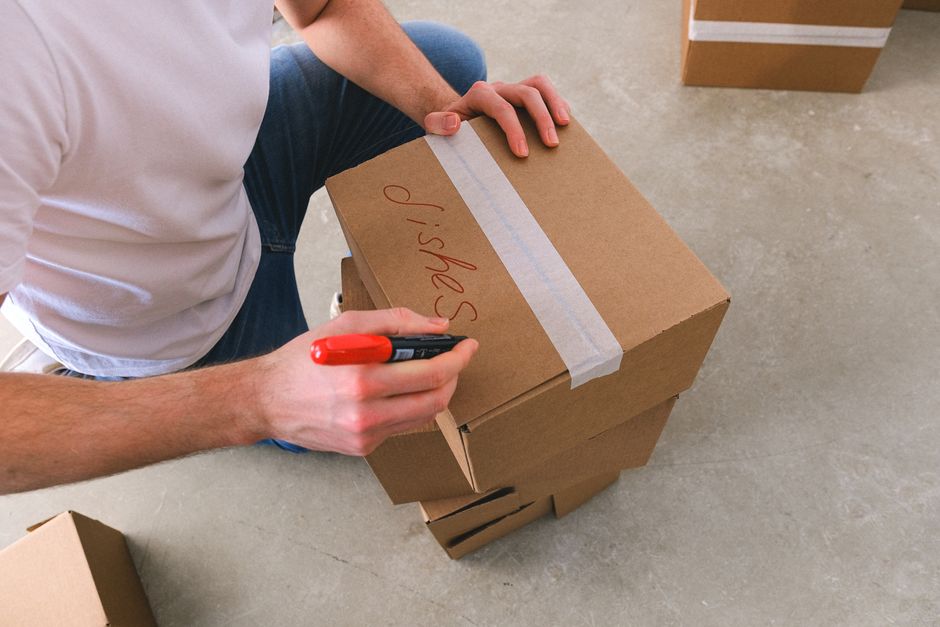
Write the destination room and a brief contents description on every visible face of the box. When boxes are stacked in a truck or against a wall, only one or two sides are visible at any given time. If you only label the top, that information disappears the moment another box is placed on top of it. Labeling all four sides means the information is always accessible no matter how the box is stacked or oriented.
Step 2 — Apply Your Color-Code System
Run a strip of colored tape along the top edge of the box on all four sides, or stick a large colored dot on each face. Match the color to the room using your key sheet. This gives anyone helping with your move — whether professional movers or friends and family — an immediate visual signal about where each box belongs, even before they read a single word. It dramatically speeds up the unloading process.
Step 3 — Write a Contents Summary on the Side
Under the room label, add a brief contents list. You do not need to inventory every item — a summary is enough. For example: Kitchen — pots, baking sheets, oven mitts or Master Bedroom — bedding, pillows, alarm clock. This tells you at a glance whether a box is worth opening immediately or can wait until later. It also helps you prioritize which boxes to carry in first.
Step 4 — Mark Priority Boxes Clearly
Not all boxes need to be unpacked on day one. Identify your highest-priority boxes — the ones containing items you will need in the first 24 to 48 hours — and mark them OPEN FIRST in large letters. Common candidates include:
- Toiletries, towels, and bathroom essentials
- A set of dishes, cups, and basic kitchen tools
- Phone chargers, laptop, and important documents
- Bed linens and pillows for each bedroom
- Medications and a basic first-aid kit
- Coffee maker and coffee — arguably the most critical item of all
Having these boxes clearly marked and ideally loaded last into the truck (so they come off first) means you can meet your basic needs on arrival without unpacking everything at once.
Step 5 — Add Handling Instructions Where Needed
Any box containing fragile, heavy, or unusual items deserves a handling note. Write FRAGILE, HEAVY, or THIS SIDE UP on all sides of the relevant box, not just the top. For particularly delicate items, consider a brief note such as Fragile — antique mirror, handle with two people. The more information you provide, the less guesswork your movers have to do — and the safer your valuables will be in transit.
Common Box Labeling Mistakes to Avoid
Even people who intend to label every box well tend to fall into a few predictable traps. Knowing these mistakes in advance helps you sidestep them entirely.
Only Labeling the Top
As mentioned above, top-only labels disappear the moment the box is stacked. Always label at least two opposite sides in addition to the top, and ideally all four sides. The few extra seconds are worth it every single time.
Using Vague Room Names
Labels like Misc or Stuff are essentially useless on move-in day. If you have two home offices, label them Office — Desk Side and Office — Bookcase Side rather than both as Office. If you have multiple bedrooms, use names: Kids Room — Emma or Guest Room. The more specific you are, the faster everything lands in the right place.
Skipping the Contents List
A room label tells movers where a box goes. A contents list tells you whether you need to open it tonight. Without a contents list, you end up opening every single box hunting for the one item you need — which defeats the purpose of a labeling system entirely.
Labeling After Sealing
Try to label the box before you seal it, or at least immediately after. If you set sealed boxes aside and plan to label them in a batch later, you will almost certainly skip some or forget what is inside. Build labeling into the packing step, not as a separate task afterward.
Digital Labeling: A Useful Optional Upgrade
For larger moves or households with a significant number of boxes, a digital inventory can complement your physical labels. Write a box number on each box — Box 1, Box 2, and so on — and keep a corresponding spreadsheet or phone note listing the full contents of each numbered box. Apps designed for home inventories can also serve this purpose.
This approach is particularly useful if you are moving items into storage before your new home is ready, since you may not have immediate access to every box. Being able to look up Box 47 — camping gear, holiday decorations saves you from opening and resealing boxes unnecessarily.
A digital system is optional and adds a layer of effort during packing. Whether it is worth it depends on the size of your move and how long some boxes may remain unopened. For a standard household move where you plan to unpack within a few weeks, a solid physical labeling system is usually all you need.
Putting It All Together on Move Day
Once your boxes are packed, labeled, and color-coded, share the color-key with your movers before a single box leaves the truck. Post the key at the entrance of your new home so the destination for each color is visible at a glance. Direct your movers to place boxes in the correct rooms rather than piling everything in the garage or living room — this is the single biggest factor in whether unpacking feels manageable or overwhelming.
If you are working with a professional moving crew, a clear labeling system also speeds up the unloading phase, which can reduce your total billable time. Well-labeled boxes mean fewer questions, fewer trips to the wrong room, and a cleaner result at the end of the day.
For help making your next move as smooth as possible from start to finish, the Men on Mission team is ready to step in. Call us at 719-357-9048 or visit our site to get a free quote and lock in your moving date.
Knowing how to label moving boxes correctly is one of the most underrated skills in a successful relocation. Most people write a room name on the top of a box and call it done — then spend three frustrating days at their new home tearing through stacks trying to find the coffee maker. A thoughtful labeling system takes an extra few minutes per box during packing but saves hours of confusion when you are exhausted and desperate to settle in.
If you would like professional movers to handle the heavy lifting so you can focus on getting organized, call our team at 719-357-9048 to lock in your move date.
Whether you are moving across Colorado Springs or relocating to another state entirely, the labeling strategies below are designed to work for any size household. Apply them consistently and your move-in day will feel far more manageable from the very first box carried through the door.
Why Box Labeling Makes Such a Big Difference
It is easy to underestimate how chaotic an unlabeled stack of boxes becomes once you are standing in an empty new home. Every box looks identical. You remember packing the bathroom essentials, but you cannot remember which of the twelve medium boxes they ended up in. You need a screwdriver to assemble the bed frame, but the tools are buried somewhere in the garage pile.
A clear labeling system solves these problems before they start. When every box carries specific information — destination room, general contents, and any special handling instructions — movers can place each box in the correct room on arrival. That means you are not relocating boxes a second time yourself, and you know exactly where to look when you need something urgently.
Proper labeling also helps protect your belongings. A box marked FRAGILE — This Side Up on all four sides is far less likely to be flipped or stacked under something heavy than one that carries no markings at all. The few seconds it takes to write that warning can prevent a broken lamp or shattered dish.
Supplies You Need Before You Start Labeling
You do not need an elaborate system to label boxes well. A handful of inexpensive supplies make the process faster and the results much more readable.
- Thick permanent markers — use at least a medium-tip permanent marker so your writing is legible from across the room. A fine-tip pen disappears on cardboard.
- Color-coded tape or colored dot stickers — assign one color per room. Blue for the master bedroom, green for the kitchen, red for the living room, and so on. Movers can sort boxes at a glance without reading a single word.
- Pre-printed moving labels — available at office supply stores and online, these include fields for room, contents, and priority. Useful if your handwriting is difficult to read under stress.
- Blank adhesive labels or masking tape — for writing detailed contents lists on the side of each box.
- A simple color-key sheet — tape one copy to the moving truck door and post another at the entrance of your new home so movers can match colors to rooms without asking you every few minutes.
A Step-by-Step Box Labeling System That Works
The goal of a good labeling system is to communicate two things instantly: where the box goes and what is inside. Here is the approach professional organizers and experienced movers consistently recommend.
Step 1 — Label All Four Sides and the Top
Write the destination room and a brief contents description on every visible face of the box. When boxes are stacked in a truck or against a wall, only one or two sides are visible at any given time. If you only label the top, that information disappears the moment another box is placed on top of it. Labeling all four sides means the information is always accessible no matter how the box is stacked or oriented.
Step 2 — Apply Your Color-Code System
Run a strip of colored tape along the top edge of the box on all four sides, or stick a large colored dot on each face. Match the color to the room using your key sheet. This gives anyone helping with your move — whether professional movers or friends and family — an immediate visual signal about where each box belongs, even before they read a single word. It dramatically speeds up the unloading process.
Step 3 — Write a Contents Summary on the Side
Under the room label, add a brief contents list. You do not need to inventory every item — a summary is enough. For example: Kitchen — pots, baking sheets, oven mitts or Master Bedroom — bedding, pillows, alarm clock. This tells you at a glance whether a box is worth opening immediately or can wait until later. It also helps you prioritize which boxes to carry in first.
Step 4 — Mark Priority Boxes Clearly
Not all boxes need to be unpacked on day one. Identify your highest-priority boxes — the ones containing items you will need in the first 24 to 48 hours — and mark them OPEN FIRST in large letters. Common candidates include:
- Toiletries, towels, and bathroom essentials
- A set of dishes, cups, and basic kitchen tools
- Phone chargers, laptop, and important documents
- Bed linens and pillows for each bedroom
- Medications and a basic first-aid kit
- Coffee maker and coffee — arguably the most critical item of all
Having these boxes clearly marked and ideally loaded last into the truck (so they come off first) means you can meet your basic needs on arrival without unpacking everything at once.
Step 5 — Add Handling Instructions Where Needed
Any box containing fragile, heavy, or unusual items deserves a handling note. Write FRAGILE, HEAVY, or THIS SIDE UP on all sides of the relevant box, not just the top. For particularly delicate items, consider a brief note such as Fragile — antique mirror, handle with two people. The more information you provide, the less guesswork your movers have to do — and the safer your valuables will be in transit.
Common Box Labeling Mistakes to Avoid
Even people who intend to label every box well tend to fall into a few predictable traps. Knowing these mistakes in advance helps you sidestep them entirely.
Only Labeling the Top
As mentioned above, top-only labels disappear the moment the box is stacked. Always label at least two opposite sides in addition to the top, and ideally all four sides. The few extra seconds are worth it every single time.
Using Vague Room Names
Labels like Misc or Stuff are essentially useless on move-in day. If you have two home offices, label them Office — Desk Side and Office — Bookcase Side rather than both as Office. If you have multiple bedrooms, use names: Kids Room — Emma or Guest Room. The more specific you are, the faster everything lands in the right place.
Skipping the Contents List
A room label tells movers where a box goes. A contents list tells you whether you need to open it tonight. Without a contents list, you end up opening every single box hunting for the one item you need — which defeats the purpose of a labeling system entirely.
Labeling After Sealing
Try to label the box before you seal it, or at least immediately after. If you set sealed boxes aside and plan to label them in a batch later, you will almost certainly skip some or forget what is inside. Build labeling into the packing step, not as a separate task afterward.
Digital Labeling: A Useful Optional Upgrade
For larger moves or households with a significant number of boxes, a digital inventory can complement your physical labels. Write a box number on each box — Box 1, Box 2, and so on — and keep a corresponding spreadsheet or phone note listing the full contents of each numbered box. Apps designed for home inventories can also serve this purpose.
This approach is particularly useful if you are moving items into storage before your new home is ready, since you may not have immediate access to every box. Being able to look up Box 47 — camping gear, holiday decorations saves you from opening and resealing boxes unnecessarily.
A digital system is optional and adds a layer of effort during packing. Whether it is worth it depends on the size of your move and how long some boxes may remain unopened. For a standard household move where you plan to unpack within a few weeks, a solid physical labeling system is usually all you need.
Putting It All Together on Move Day
Once your boxes are packed, labeled, and color-coded, share the color-key with your movers before a single box leaves the truck. Post the key at the entrance of your new home so the destination for each color is visible at a glance. Direct your movers to place boxes in the correct rooms rather than piling everything in the garage or living room — this is the single biggest factor in whether unpacking feels manageable or overwhelming.
If you are working with a professional moving crew, a clear labeling system also speeds up the unloading phase, which can reduce your total billable time. Well-labeled boxes mean fewer questions, fewer trips to the wrong room, and a cleaner result at the end of the day.
For help making your next move as smooth as possible from start to finish, the Men on Mission team is ready to step in. Call us at 719-357-9048 or visit our site to get a free quote and lock in your moving date.
Have Questions About Your Move?

What is the best way to label moving boxes?
The most effective approach is to label all four sides and the top of every box with the destination room and a brief contents summary. Add a color-coded tape or sticker that corresponds to a specific room so movers can sort boxes visually without reading every label. Mark fragile or priority boxes clearly as well.
Should I label the top or the sides of moving boxes?
Always label the sides as well as the top. Top-only labels become invisible the moment another box is stacked on top. Labeling at least two opposite sides — and ideally all four — ensures the destination and contents information is visible no matter how boxes are stacked in the truck or in your new home.
What should I write on a moving box label?
At minimum, write the destination room and a brief description of the contents. For example: 'Kitchen — pots, mixing bowls, spice jars.' Also include any handling instructions such as 'Fragile,' 'Heavy,' or 'This Side Up,' and mark your highest-priority boxes with 'Open First' so you can find essentials quickly after arrival.