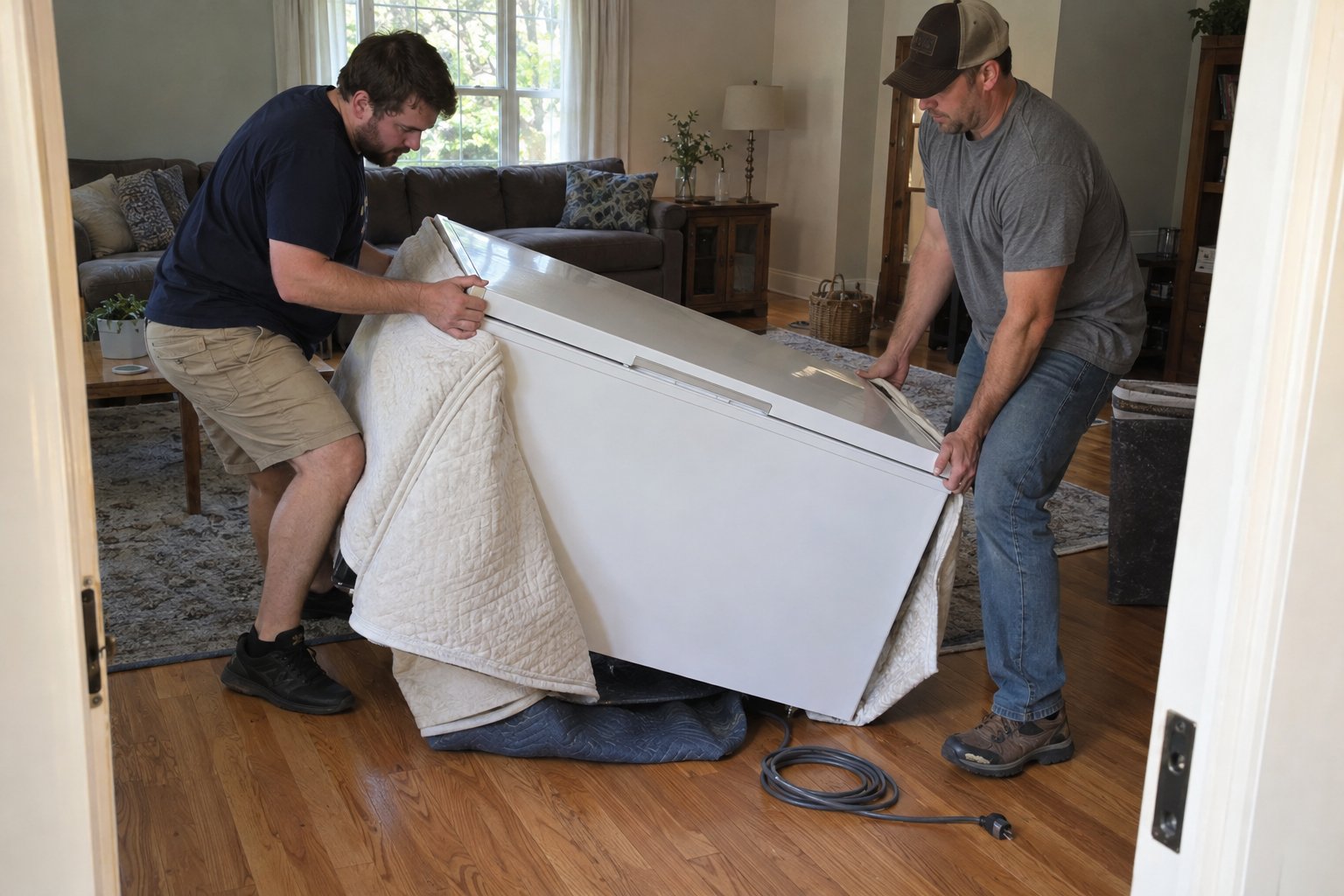
Can a chest freezer be transported on its side? In most cases, yes, a chest freezer can be laid on its side for transport without permanent damage, as long as you let it sit upright again for several hours before plugging it back in. The real risk is not the tipping itself, it is the compressor oil that can shift out of place and the frost or standing water that turns into a mess once the unit is tilted.
Chest freezers are not built quite like upright refrigerators, and that difference matters once you start loading a truck. Their compressors and sealed systems tend to tolerate a sideways ride better than a standing fridge does, but "tolerate" does not mean "ignore the risk." If you are moving one across town or across the state, a few precautions before, during, and after transport make the difference between a freezer that hums back to life and one that trips a breaker or never gets properly cold again.
Is It Actually Safe to Lay a Chest Freezer on Its Side?
Yes, laying a chest freezer on its side is generally considered safe for transport, and it is often the only practical way to fit one through a doorway, up a ramp, or into a smaller vehicle. The compressor and refrigerant lines in most chest freezers are mounted in a way that handles a brief tilt or flat ride without leaking or cracking, which is different from an upright refrigerator or an upright freezer, where the compressor and oil reservoir are more sensitive to orientation changes.
That said, "generally safe" comes with conditions. The freezer should be fully defrosted and dry before it goes on its side, the lid needs to be secured so it cannot swing open, and the unit should not stay tilted for an extended multi-day haul if you can avoid it. Manufacturers vary slightly in their guidance, so if you still have the owner's manual or can find the model online, a quick check is worth the five minutes.
Why Orientation Matters for the Compressor
The compressor relies on oil pooling in a specific spot to lubricate itself when it starts back up. Tilting the unit can let that oil migrate into the cooling lines. It usually settles back into place within a few hours of the freezer sitting upright again, which is why the waiting period after the move is not optional, it is the step that protects the compressor from running dry.
How to Defrost and Prep a Chest Freezer Before a Move
Prepping a chest freezer for transport starts at least 24 to 48 hours before moving day: empty it, unplug it, let it fully defrost, and dry out every surface so no water sloshes around once it is tilted or jostled in the truck. Skipping this step is the single most common reason people end up with a soaked moving blanket, a puddle in the truck, or mildew building up inside the gasket weeks later.
- Empty and sort the contents early enough that you are not scrambling on moving day. Decide what gets eaten, what gets coolers and ice, and what gets left behind.
- Unplug the unit and prop the lid open to speed up defrosting and let air circulate.
- Towel-dry the interior once the ice has melted, including the door gasket and any drainage channel, since trapped moisture is what leads to mildew smell after the move.
- Tape down loose parts like baskets, dividers, or shelves so they do not shift and scratch the interior while the unit is tilted.
How to Move a Chest Freezer Without Damaging It
Moving a chest freezer safely comes down to keeping it upright whenever you can, securing the lid before you tilt it, and using an appliance dolly with straps rather than trying to muscle it by hand. These units are heavier and more awkward than they look once they are empty, since the weight is concentrated low and wide rather than in a shape built for carrying.
Securing the Lid and Cord
Wrap a moving strap or heavy tape around the lid so it cannot pop open mid-transport, and coil the power cord and tape it to the back so it does not drag or snag on a doorway. A furniture dolly with straps, rather than a two-wheel hand truck, gives you more control when the unit needs to tip onto its side to clear a hallway or staircase.
Loading It Into the Truck
If the freezer must ride on its side to save space, place it on the side opposite the compressor housing if your model has one clearly indicated, pad it with moving blankets, and brace it so it cannot slide or tip further during the drive. Keep it away from the edge of a stack where a shift in cargo could tip it onto a sharp corner. For a load with multiple large appliances, professional loading and unloading services are worth considering since correct bracing is as much about the rest of the truck's load as it is about the freezer itself.
How Long Should a Chest Freezer Sit Before You Plug It In?
Let a chest freezer that traveled on its side sit upright for at least three to four hours before plugging it in, and give it closer to 24 hours if the move was long, hot, or the unit was tilted for more than a short stretch. This waiting period lets the compressor oil settle back into position so the motor is not forced to run without proper lubrication.
Once it is plugged in, give the unit several hours to reach its target temperature before loading food back inside. Running it empty first also lets you catch any issue, like an unusual noise or a unit that is not cooling, while there is nothing inside that could spoil.
What If the Freezer Isn't Cooling After the Move?
A chest freezer that will not cool after a move has usually not been given enough rest time, or it was run immediately after unloading instead of being left upright first. Before assuming something is broken, unplug it, let it sit for several more hours, and try again, since a stressed compressor often just needs the extra settling time.
If it still will not cool after a full rest period, check that the outlet is working, that the thermostat has not been bumped to its lowest setting, and that the condenser coils are not blocked by a wall or furniture placed too close behind it. A persistent failure to cool after a proper rest period usually points to a compressor issue rather than something you can fix with more waiting, and at that point it is worth contacting a technician rather than troubleshooting further on your own.
Appliances like chest freezers are exactly the kind of item that benefits from a second set of trained hands, particularly if yours is a large upright-style chest model that needs to go down a staircase or through a narrow hallway. If you would rather not take the risk with a compressor-driven appliance, our specialty item moving service covers large and awkward pieces that need careful handling and the right equipment. For the rest of the move, you can get a moving quote and let us handle the heavy lifting alongside it.
Frequently Asked Questions
Does a chest freezer need to stay upright the whole time during a move?
No, it does not need to stay upright the entire time. Laying it on its side briefly to fit through a doorway or into a truck is generally fine as long as it is defrosted, dry, and secured, and you let it sit upright again for several hours before plugging it back in.
Can you lay a chest freezer flat on its back instead of its side?
It is better to keep a chest freezer on its side or upright rather than flat on its back or front, since lying face up or face down puts more strain on the lid seal and can let compressor oil pool in the wrong place for longer.
How long does a chest freezer need to defrost before a move?
Most chest freezers need 24 to 48 hours unplugged with the lid open to fully defrost, depending on how much frost has built up. Towel-drying the interior once the ice melts helps avoid moisture damage during transport.
Will moving a chest freezer on its side damage the compressor?
It is unlikely to cause permanent damage if the unit is allowed to rest upright for several hours before being plugged back in. Plugging it in immediately after a tilted ride is the more common cause of compressor strain.
Is it safe to transport a chest freezer with food still inside?
It is not recommended. Food left inside adds weight, makes the unit harder to secure and maneuver, and risks spilling or spoiling once the freezer is unplugged and tilted for transport.
Can a chest freezer be transported on its side? In most cases, yes, a chest freezer can be laid on its side for transport without permanent damage, as long as you let it sit upright again for several hours before plugging it back in. The real risk is not the tipping itself, it is the compressor oil that can shift out of place and the frost or standing water that turns into a mess once the unit is tilted.
Chest freezers are not built quite like upright refrigerators, and that difference matters once you start loading a truck. Their compressors and sealed systems tend to tolerate a sideways ride better than a standing fridge does, but "tolerate" does not mean "ignore the risk." If you are moving one across town or across the state, a few precautions before, during, and after transport make the difference between a freezer that hums back to life and one that trips a breaker or never gets properly cold again.
Is It Actually Safe to Lay a Chest Freezer on Its Side?
Yes, laying a chest freezer on its side is generally considered safe for transport, and it is often the only practical way to fit one through a doorway, up a ramp, or into a smaller vehicle. The compressor and refrigerant lines in most chest freezers are mounted in a way that handles a brief tilt or flat ride without leaking or cracking, which is different from an upright refrigerator or an upright freezer, where the compressor and oil reservoir are more sensitive to orientation changes.
That said, "generally safe" comes with conditions. The freezer should be fully defrosted and dry before it goes on its side, the lid needs to be secured so it cannot swing open, and the unit should not stay tilted for an extended multi-day haul if you can avoid it. Manufacturers vary slightly in their guidance, so if you still have the owner's manual or can find the model online, a quick check is worth the five minutes.
Why Orientation Matters for the Compressor
The compressor relies on oil pooling in a specific spot to lubricate itself when it starts back up. Tilting the unit can let that oil migrate into the cooling lines. It usually settles back into place within a few hours of the freezer sitting upright again, which is why the waiting period after the move is not optional, it is the step that protects the compressor from running dry.
How to Defrost and Prep a Chest Freezer Before a Move
Prepping a chest freezer for transport starts at least 24 to 48 hours before moving day: empty it, unplug it, let it fully defrost, and dry out every surface so no water sloshes around once it is tilted or jostled in the truck. Skipping this step is the single most common reason people end up with a soaked moving blanket, a puddle in the truck, or mildew building up inside the gasket weeks later.
- Empty and sort the contents early enough that you are not scrambling on moving day. Decide what gets eaten, what gets coolers and ice, and what gets left behind.
- Unplug the unit and prop the lid open to speed up defrosting and let air circulate.
- Towel-dry the interior once the ice has melted, including the door gasket and any drainage channel, since trapped moisture is what leads to mildew smell after the move.
- Tape down loose parts like baskets, dividers, or shelves so they do not shift and scratch the interior while the unit is tilted.
How to Move a Chest Freezer Without Damaging It
Moving a chest freezer safely comes down to keeping it upright whenever you can, securing the lid before you tilt it, and using an appliance dolly with straps rather than trying to muscle it by hand. These units are heavier and more awkward than they look once they are empty, since the weight is concentrated low and wide rather than in a shape built for carrying.
Securing the Lid and Cord
Wrap a moving strap or heavy tape around the lid so it cannot pop open mid-transport, and coil the power cord and tape it to the back so it does not drag or snag on a doorway. A furniture dolly with straps, rather than a two-wheel hand truck, gives you more control when the unit needs to tip onto its side to clear a hallway or staircase.
Loading It Into the Truck
If the freezer must ride on its side to save space, place it on the side opposite the compressor housing if your model has one clearly indicated, pad it with moving blankets, and brace it so it cannot slide or tip further during the drive. Keep it away from the edge of a stack where a shift in cargo could tip it onto a sharp corner. For a load with multiple large appliances, professional loading and unloading services are worth considering since correct bracing is as much about the rest of the truck's load as it is about the freezer itself.
How Long Should a Chest Freezer Sit Before You Plug It In?
Let a chest freezer that traveled on its side sit upright for at least three to four hours before plugging it in, and give it closer to 24 hours if the move was long, hot, or the unit was tilted for more than a short stretch. This waiting period lets the compressor oil settle back into position so the motor is not forced to run without proper lubrication.
Once it is plugged in, give the unit several hours to reach its target temperature before loading food back inside. Running it empty first also lets you catch any issue, like an unusual noise or a unit that is not cooling, while there is nothing inside that could spoil.
What If the Freezer Isn't Cooling After the Move?
A chest freezer that will not cool after a move has usually not been given enough rest time, or it was run immediately after unloading instead of being left upright first. Before assuming something is broken, unplug it, let it sit for several more hours, and try again, since a stressed compressor often just needs the extra settling time.
If it still will not cool after a full rest period, check that the outlet is working, that the thermostat has not been bumped to its lowest setting, and that the condenser coils are not blocked by a wall or furniture placed too close behind it. A persistent failure to cool after a proper rest period usually points to a compressor issue rather than something you can fix with more waiting, and at that point it is worth contacting a technician rather than troubleshooting further on your own.
Appliances like chest freezers are exactly the kind of item that benefits from a second set of trained hands, particularly if yours is a large upright-style chest model that needs to go down a staircase or through a narrow hallway. If you would rather not take the risk with a compressor-driven appliance, our specialty item moving service covers large and awkward pieces that need careful handling and the right equipment. For the rest of the move, you can get a moving quote and let us handle the heavy lifting alongside it.
Have Questions About Your Move?

Does a chest freezer need to stay upright the whole time during a move?
No, it does not need to stay upright the entire time. Laying it on its side briefly to fit through a doorway or into a truck is generally fine as long as it is defrosted, dry, and secured, and you let it sit upright again for several hours before plugging it back in.
Can you lay a chest freezer flat on its back instead of its side?
It is better to keep a chest freezer on its side or upright rather than flat on its back or front, since lying face up or face down puts more strain on the lid seal and can let compressor oil pool in the wrong place for longer.
How long does a chest freezer need to defrost before a move?
Most chest freezers need 24 to 48 hours unplugged with the lid open to fully defrost, depending on how much frost has built up. Towel-drying the interior once the ice melts helps avoid moisture damage during transport.
Will moving a chest freezer on its side damage the compressor?
It is unlikely to cause permanent damage if the unit is allowed to rest upright for several hours before being plugged back in. Plugging it in immediately after a tilted ride is the more common cause of compressor strain.
Is it safe to transport a chest freezer with food still inside?
It is not recommended. Food left inside adds weight, makes the unit harder to secure and maneuver, and risks spilling or spoiling once the freezer is unplugged and tilted for transport.