Knowing how to pack books for moving comes down to two things most people get wrong on the first try: they use boxes that are too big, and they pack books flat when they should be packed upright. Books are deceptively heavy in bulk, and a box that looks half-full can already be at the weight limit a person can safely carry. Get the box size and packing orientation right, and the rest of the process is mostly patience.
This guide covers the specific techniques for packing books without warping covers, cracking spines, or throwing your back out carrying them down a flight of stairs. If your book collection is one part of a bigger packing job, our professional packing services can take the whole house off your plate, not just the shelves.
What Are the Best Boxes for Packing Books?
Small to medium boxes are the best boxes for packing books, not the large ones you would use for pillows or linens. A full box of hardcovers at the size movers typically call "large" can weigh well over 50 pounds, which is difficult to lift safely and puts real strain on the box's bottom seam.
Look for boxes in the 1.5 cubic foot range for dense hardcovers, and reserve medium boxes for paperbacks or a mix of book sizes. Double-walled boxes are worth the extra cost for books because the corrugation resists bowing under weight in a way single-wall boxes do not. Reinforce the bottom of every book box with an extra strip of tape along the center seam before you load anything, since that seam is where overloaded boxes fail.
How to Pack Books So They Don't Bend or Warp
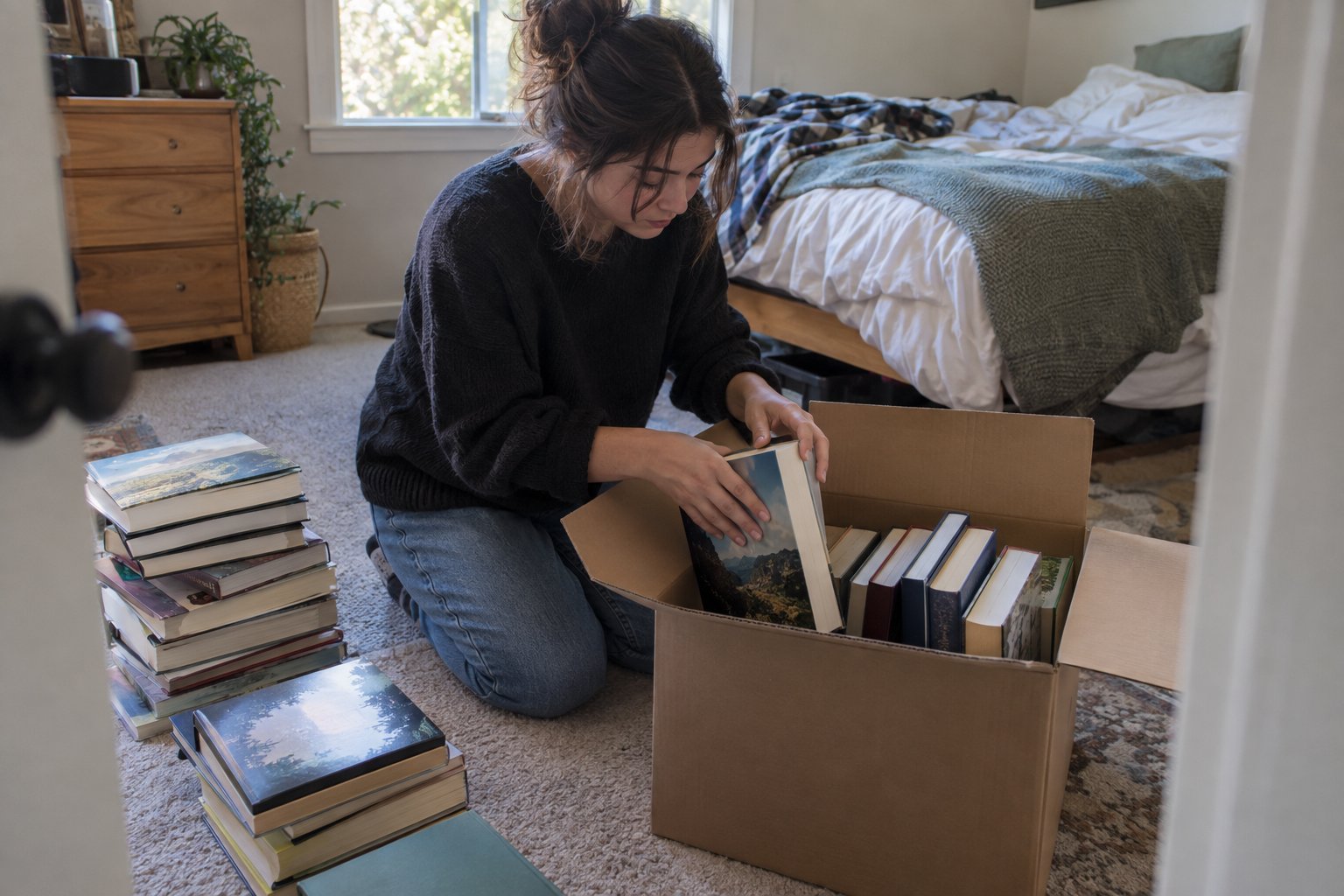
Pack books upright, spine down, the same way they sit on a shelf, rather than flat in stacks. Stacking books flat puts the full weight of the pile on the bottom covers, and over time (or over a long drive) that weight bends covers and creases pages.
Alternate the direction of the spines as you go, with one book's spine facing the front of the box and the next facing the back. This keeps the row tight and stops books from leaning and slumping sideways once the box is moving. Fill any gap at the end of a row with crumpled paper rather than jamming in one more book at an angle; a book wedged in sideways is the one most likely to arrive with a bent cover. Fragile or older books can get an extra layer of soft paper wrapped around the covers before they go in the row, which cushions the corners against the books on either side.
Packing Rare, Valuable, or Antique Books
Rare and valuable books need individual wrapping and a dedicated box, never mixed in with everyday paperbacks. A first edition or a family Bible can be damaged by nothing more than the shifting weight of ordinary hardcovers packed against it.
Wrap each valuable book individually in acid-free paper if you have it, or plain unprinted paper if you do not; newspaper ink can transfer onto covers and pages over time. Lay these books flat in a smaller box, spine-side alternating as you build shallow layers, and keep the layers thin so nothing is bearing significant weight from above. Leave a cushion of crumpled paper on all sides and label the box clearly on the top and at least one side so it never gets stacked under something heavy or flipped upside down during loading.
How Do You Move Heavy Boxes of Books Without Hurting Yourself?
Keep every book box light enough to lift with your legs and close to your body, not your back. A general guideline is to stop filling a book box once it reaches a weight you could comfortably carry up a flight of stairs, which for most people is well under the point where a box "looks full."
Test a packed box before sealing it by lifting it as if you were carrying it, not just from the floor. Two people can share the load on any box that still feels heavy after that test, using the two-handle carry rather than one person hunching over it. Stack book boxes no more than two or three high on a dolly, and keep them on the bottom of any stack in the truck since they are among the densest, most stable items you will load. Crews handling loading and unloading services will typically ask which boxes are heaviest so they can plan the truck accordingly, so flag your book boxes before they start.
Should You Donate or Store Books Instead of Moving Them All?
It is worth sorting your collection before you pack a single box, since books are one of the easiest categories to downsize without much regret. Decide which books you actually reread or reference, which are sentimental, and which have simply been sitting on a shelf for years unopened.
Books you rarely use but are not ready to part with are also good candidates for storage rather than your moving truck, especially if you are downsizing into a smaller home. Our guide on preserving a book collection in storage covers the humidity and shelving details that matter once boxes are no longer moving to a new home right away. Donating duplicate copies, outdated textbooks, or books in a genre you no longer read cuts down on both boxes and lifting on moving day.
Labeling and Unloading Book Boxes
Label book boxes with both the room they belong in and the word "books" in large letters on the top and one side, since their weight is not always obvious from the outside. This matters more for books than most other items because a mislabeled book box is the one most likely to get set down hard by someone expecting it to be light.
If you are organizing by shelf or by subject, number the boxes and keep a simple list of what is in each one; this turns unpacking into a matter of matching numbers to shelves instead of re-sorting your whole library from scratch. Once boxes are unpacked, our piece on setting up a home library walks through shelving systems that make a large collection easy to browse again. Unload book boxes onto shelves as soon as reasonably possible after the move, since books left boxed for weeks in a garage or basement are exposed to humidity swings that can warp covers and encourage mildew.
If your move includes a large library along with the rest of the house, it is worth getting a sense of the full job before moving day. Get a moving quote and mention the book collection so the crew can plan for it.
Frequently Asked Questions
How many books can fit in a small moving box without it being too heavy?
Most small boxes (around 1.5 cubic feet) hold 20 to 30 average hardcovers before the box gets uncomfortably heavy to carry. Dense books like textbooks or oversized hardcovers will fill the weight limit well before the box looks full, so stop by feel rather than by how much empty space is left.
Do I need special boxes to pack books, or will any box work?
Regular boxes work fine as long as they are small to medium sized and double-walled if possible. What matters more than the box brand is size: oversized boxes tempt people to overload them, and that is what causes bottoms to give out.
Can I pack books in suitcases or plastic bins instead of cardboard boxes?
Yes, suitcases with wheels are actually a good option for books since their built-in structure handles weight well and the wheels save your back. Plastic bins work too, though you should still avoid overfilling them for the same reasons that apply to cardboard boxes.
How do you pack a box of books so it doesn't collapse on the bottom?
Reinforce the bottom seam with an extra strip of packing tape before loading anything, and keep the total weight moderate rather than maximizing every cubic inch. A collapsed bottom is almost always the result of an overloaded box, not a defective one.
Is it better to pack books flat or standing up in a moving box?
Standing up, spine down, the way they sit on a shelf, is better for most books because it distributes weight evenly and avoids bending covers. Flat stacking is only preferable for a small number of oversized art books or fragile antique volumes that need individual cushioning rather than shelf-style packing.
Knowing how to pack books for moving comes down to two things most people get wrong on the first try: they use boxes that are too big, and they pack books flat when they should be packed upright. Books are deceptively heavy in bulk, and a box that looks half-full can already be at the weight limit a person can safely carry. Get the box size and packing orientation right, and the rest of the process is mostly patience.
This guide covers the specific techniques for packing books without warping covers, cracking spines, or throwing your back out carrying them down a flight of stairs. If your book collection is one part of a bigger packing job, our professional packing services can take the whole house off your plate, not just the shelves.
What Are the Best Boxes for Packing Books?
Small to medium boxes are the best boxes for packing books, not the large ones you would use for pillows or linens. A full box of hardcovers at the size movers typically call "large" can weigh well over 50 pounds, which is difficult to lift safely and puts real strain on the box's bottom seam.
Look for boxes in the 1.5 cubic foot range for dense hardcovers, and reserve medium boxes for paperbacks or a mix of book sizes. Double-walled boxes are worth the extra cost for books because the corrugation resists bowing under weight in a way single-wall boxes do not. Reinforce the bottom of every book box with an extra strip of tape along the center seam before you load anything, since that seam is where overloaded boxes fail.
How to Pack Books So They Don't Bend or Warp
Pack books upright, spine down, the same way they sit on a shelf, rather than flat in stacks. Stacking books flat puts the full weight of the pile on the bottom covers, and over time (or over a long drive) that weight bends covers and creases pages.
Alternate the direction of the spines as you go, with one book's spine facing the front of the box and the next facing the back. This keeps the row tight and stops books from leaning and slumping sideways once the box is moving. Fill any gap at the end of a row with crumpled paper rather than jamming in one more book at an angle; a book wedged in sideways is the one most likely to arrive with a bent cover. Fragile or older books can get an extra layer of soft paper wrapped around the covers before they go in the row, which cushions the corners against the books on either side.
Packing Rare, Valuable, or Antique Books
Rare and valuable books need individual wrapping and a dedicated box, never mixed in with everyday paperbacks. A first edition or a family Bible can be damaged by nothing more than the shifting weight of ordinary hardcovers packed against it.
Wrap each valuable book individually in acid-free paper if you have it, or plain unprinted paper if you do not; newspaper ink can transfer onto covers and pages over time. Lay these books flat in a smaller box, spine-side alternating as you build shallow layers, and keep the layers thin so nothing is bearing significant weight from above. Leave a cushion of crumpled paper on all sides and label the box clearly on the top and at least one side so it never gets stacked under something heavy or flipped upside down during loading.
How Do You Move Heavy Boxes of Books Without Hurting Yourself?
Keep every book box light enough to lift with your legs and close to your body, not your back. A general guideline is to stop filling a book box once it reaches a weight you could comfortably carry up a flight of stairs, which for most people is well under the point where a box "looks full."
Test a packed box before sealing it by lifting it as if you were carrying it, not just from the floor. Two people can share the load on any box that still feels heavy after that test, using the two-handle carry rather than one person hunching over it. Stack book boxes no more than two or three high on a dolly, and keep them on the bottom of any stack in the truck since they are among the densest, most stable items you will load. Crews handling loading and unloading services will typically ask which boxes are heaviest so they can plan the truck accordingly, so flag your book boxes before they start.
Should You Donate or Store Books Instead of Moving Them All?
It is worth sorting your collection before you pack a single box, since books are one of the easiest categories to downsize without much regret. Decide which books you actually reread or reference, which are sentimental, and which have simply been sitting on a shelf for years unopened.
Books you rarely use but are not ready to part with are also good candidates for storage rather than your moving truck, especially if you are downsizing into a smaller home. Our guide on preserving a book collection in storage covers the humidity and shelving details that matter once boxes are no longer moving to a new home right away. Donating duplicate copies, outdated textbooks, or books in a genre you no longer read cuts down on both boxes and lifting on moving day.
Labeling and Unloading Book Boxes
Label book boxes with both the room they belong in and the word "books" in large letters on the top and one side, since their weight is not always obvious from the outside. This matters more for books than most other items because a mislabeled book box is the one most likely to get set down hard by someone expecting it to be light.
If you are organizing by shelf or by subject, number the boxes and keep a simple list of what is in each one; this turns unpacking into a matter of matching numbers to shelves instead of re-sorting your whole library from scratch. Once boxes are unpacked, our piece on setting up a home library walks through shelving systems that make a large collection easy to browse again. Unload book boxes onto shelves as soon as reasonably possible after the move, since books left boxed for weeks in a garage or basement are exposed to humidity swings that can warp covers and encourage mildew.
If your move includes a large library along with the rest of the house, it is worth getting a sense of the full job before moving day. Get a moving quote and mention the book collection so the crew can plan for it.
Have Questions About Your Move?
How many books can fit in a small moving box without it being too heavy?
Most small boxes (around 1.5 cubic feet) hold 20 to 30 average hardcovers before the box gets uncomfortably heavy to carry. Dense books like textbooks or oversized hardcovers will fill the weight limit well before the box looks full, so stop by feel rather than by how much empty space is left.
Do I need special boxes to pack books, or will any box work?
Regular boxes work fine as long as they are small to medium sized and double-walled if possible. What matters more than the box brand is size: oversized boxes tempt people to overload them, and that is what causes bottoms to give out.
Can I pack books in suitcases or plastic bins instead of cardboard boxes?
Yes, suitcases with wheels are actually a good option for books since their built-in structure handles weight well and the wheels save your back. Plastic bins work too, though you should still avoid overfilling them for the same reasons that apply to cardboard boxes.
How do you pack a box of books so it doesn't collapse on the bottom?
Reinforce the bottom seam with an extra strip of packing tape before loading anything, and keep the total weight moderate rather than maximizing every cubic inch. A collapsed bottom is almost always the result of an overloaded box, not a defective one.
Is it better to pack books flat or standing up in a moving box?
Standing up, spine down, the way they sit on a shelf, is better for most books because it distributes weight evenly and avoids bending covers. Flat stacking is only preferable for a small number of oversized art books or fragile antique volumes that need individual cushioning rather than shelf-style packing.