How to Move a Piano Without Damaging It or Your Home
Pianos are heavier and more delicate than most furniture. Here's how to judge the equipment and risks before deciding whether to DIY or call in pros.
Knowing how to move a piano safely comes down to one uncomfortable fact: pianos are not shaped like furniture, and they do not behave like furniture once they start moving. A piano is dense, oddly balanced, full of delicate internal parts, and often worth far more than the four or five people it takes to lift it. Treat it like a heavy dresser and you risk a cracked soundboard, a torn hammer mechanism, a smashed staircase railing, or a genuinely serious injury. This guide walks through what actually makes pianos difficult, the equipment that matters, and how to judge whether this is a job you can handle yourself or one that belongs with professionals.
Why Are Pianos So Hard to Move Compared to Other Furniture?
Pianos are hard to move because their weight is concentrated unevenly, their exterior finish scratches and dents easily, and their internal mechanisms can be knocked out of adjustment by a single hard jolt. A dresser that gets bumped survives. A piano that gets bumped the same way may need a technician's visit before it plays correctly again.
An upright piano typically weighs somewhere between 300 and 500 pounds, with most of that weight sitting toward the back near the cast iron plate and strings. A baby grand can weigh 500 to 700 pounds or more, and its weight sits low and wide rather than tall, which changes how it needs to be tilted, carried, and set down. Both types are awkward to grip because there are very few places on a piano built to be held. Bench legs, lid edges, and pedal lyres are not handles, and treating them like handles is how pieces break off mid-move.
What Equipment Do You Actually Need to Move a Piano?
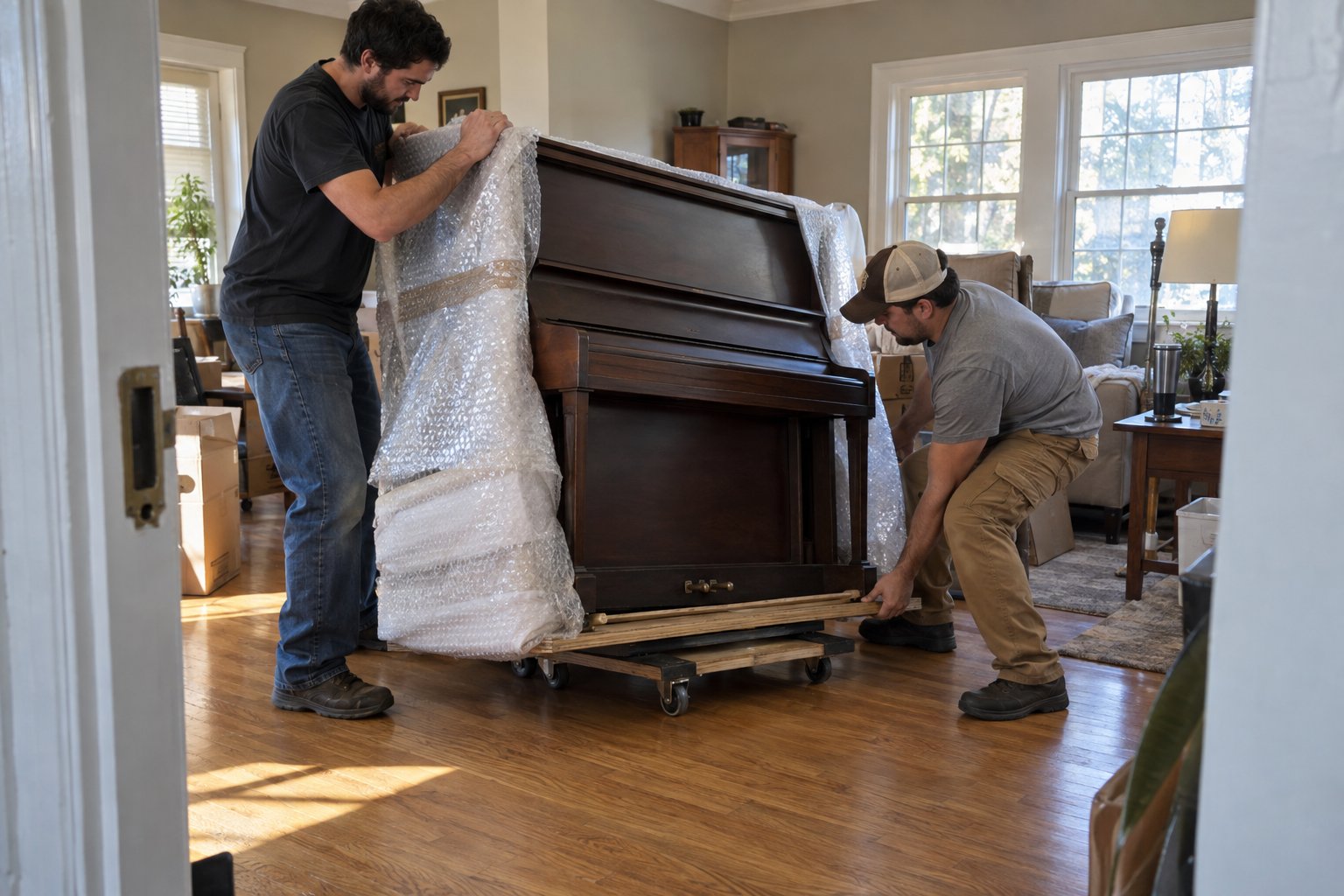
Moving a piano without the right equipment is the single biggest reason DIY piano moves go wrong. At minimum, you need a piano board or skid board, heavy-duty moving straps, furniture dollies rated for the piano's weight, and thick moving blankets, not the thin ones sold for cardboard boxes.
Piano Board or Skid Board
A piano board is a padded, rigid board that the piano gets strapped to before it is tilted onto a dolly. It spreads the piano's weight evenly and gives movers a stable base to roll instead of trying to walk a piano across a floor on its own legs or wheels, which are not designed to bear that kind of rolling load over distance.
Straps and Harnesses
Shoulder straps or a four-person lifting harness let a moving team use their legs and backs correctly instead of gripping the piano's case. This matters as much for the piano's finish as it does for the movers' spines. Grabbing the case directly is one of the fastest ways to leave permanent scratches or dents.
Dollies Rated for the Weight
A standard furniture dolly meant for boxes will not hold up under a piano's weight and can tip on an incline. Piano-specific dollies are built wider and lower to keep the center of gravity stable while rolling.
Moving an Upright Piano vs a Baby Grand: What Changes?
The core equipment is similar, but the technique differs because the weight sits in different places. An upright piano moves standing upright the entire time, strapped to a piano board and rolled on a dolly, while a grand piano has to be partially disassembled and tilted onto its side before it can be moved at all.
For an upright, the lid should be closed and latched, the fallboard covering the keys should be locked or taped shut, and the piano should be wrapped in blankets before it ever touches a dolly. For a grand piano, the legs, pedal lyre, and music desk typically need to come off first, and the exposed underside needs to be padded heavily before the piano is tilted onto the board. This disassembly step is exactly where inexperienced movers run into trouble, because grand piano hardware is often original to the instrument and not easy to source if a bolt strips or a bracket cracks.
Can You Move a Piano Down Stairs or Through Tight Doorways?
Yes, but stairs and narrow doorways are where most piano moving injuries and damage happen, so they deserve extra planning before moving day rather than being handled on the fly. Measure the doorway, hallway turns, and stairwell width against the piano's dimensions before you commit to a path, and identify a backup route in case the first one does not clear.
On stairs, the piano should be tilted no more than necessary and controlled the entire way down with straps, never let to shift its own weight. This is a two-to-four-person job depending on the piano's size, and it genuinely is not something to attempt with fewer hands than the piece requires. If your stairwell has a tight turn, a low ceiling, or a narrow landing, that is a strong signal to bring in movers who do this regularly rather than finding out mid-carry that the piano will not clear the turn. For general guidance on getting bulky pieces down a staircase safely, see our guide on moving heavy furniture down stairs.
When Does It Make Sense to Hire Professional Movers Instead?
It makes sense to hire professionals whenever the piano is a grand or baby grand, whenever stairs or tight doorways are involved, or whenever you do not already own piano-specific equipment. The cost of a professional piano move is almost always lower than the cost of repairing a piano, a staircase, or a back injury.
Professional movers bring the piano board, dolly, ramps, and straps already sized correctly, and they know how to read a piano's weight distribution before they ever lift it. That experience is hard to replicate on a first attempt, and a piano is usually not the item to learn on. If you are already coordinating other specialty items for the same move, gun safes and hot tubs carry similar weight and handling challenges, and it is often worth bundling that planning together. Our specialty item moving services are built specifically around pieces like pianos that standard moving techniques were not designed for.
What Should You Do to Prepare a Piano the Week Before the Move?
In the week before your move, confirm your piano's exact dimensions and weight class, clear a straight path from the piano's current spot to the exit, and schedule a tuning appointment for after the move rather than before it. Pianos almost always need retuning after relocation because changes in humidity, temperature, and even the vibration of transport shift the strings' tension.
It also helps to photograph the piano's current condition, front, back, and sides, so you have a clear record before it changes hands. If you are coordinating this move alongside packing the rest of the house, our broader guide to preparing your home for moving day covers the surrounding logistics so the piano is not the only thing you are thinking about that week.
A piano is one of the few household items where the safest move is often the one you do not do yourself. If you are weighing your options, our team can walk through your piano's size, your home's layout, and the path it needs to travel. Get a moving quote and we will tell you honestly what the job requires.
Frequently Asked Questions
How much does it cost to move a piano to a different room in the same house?
Moving a piano within the same house typically costs less than a full relocation because there is no truck or long transport involved, but it still requires the same equipment and technique. Many piano moving companies offer a reduced flat rate for in-home moves, though tight stairs or turns can raise the price.
Can two people safely move an upright piano by themselves?
Two people can sometimes move a small upright piano on flat, obstacle-free ground with the right equipment, but most upright pianos are heavy and awkward enough that three or four people is the safer minimum, especially if any stairs or door thresholds are involved.
Do pianos need to be moved upright or can they be laid on their side?
Upright pianos should stay upright throughout the move. Grand and baby grand pianos are designed to be tilted onto their side and secured to a padded board, since their legs and pedal lyre are removed first and the case is not built to travel any other way.
How soon after moving should a piano be tuned?
Most piano technicians recommend waiting two to four weeks after a move before tuning, since the instrument needs time to acclimate to the new room's temperature and humidity before the strings settle into a stable tension.
Will my homeowners or renters insurance cover damage from moving a piano myself?
Coverage varies by policy, and many standard homeowners or renters policies do not cover damage that happens during a self-managed move. Professional moving companies typically carry valuation coverage for high-value items like pianos, which is one reason many owners choose not to move them independently.
Knowing how to move a piano safely comes down to one uncomfortable fact: pianos are not shaped like furniture, and they do not behave like furniture once they start moving. A piano is dense, oddly balanced, full of delicate internal parts, and often worth far more than the four or five people it takes to lift it. Treat it like a heavy dresser and you risk a cracked soundboard, a torn hammer mechanism, a smashed staircase railing, or a genuinely serious injury. This guide walks through what actually makes pianos difficult, the equipment that matters, and how to judge whether this is a job you can handle yourself or one that belongs with professionals.
Why Are Pianos So Hard to Move Compared to Other Furniture?
Pianos are hard to move because their weight is concentrated unevenly, their exterior finish scratches and dents easily, and their internal mechanisms can be knocked out of adjustment by a single hard jolt. A dresser that gets bumped survives. A piano that gets bumped the same way may need a technician's visit before it plays correctly again.
An upright piano typically weighs somewhere between 300 and 500 pounds, with most of that weight sitting toward the back near the cast iron plate and strings. A baby grand can weigh 500 to 700 pounds or more, and its weight sits low and wide rather than tall, which changes how it needs to be tilted, carried, and set down. Both types are awkward to grip because there are very few places on a piano built to be held. Bench legs, lid edges, and pedal lyres are not handles, and treating them like handles is how pieces break off mid-move.
What Equipment Do You Actually Need to Move a Piano?
Moving a piano without the right equipment is the single biggest reason DIY piano moves go wrong. At minimum, you need a piano board or skid board, heavy-duty moving straps, furniture dollies rated for the piano's weight, and thick moving blankets, not the thin ones sold for cardboard boxes.
Piano Board or Skid Board
A piano board is a padded, rigid board that the piano gets strapped to before it is tilted onto a dolly. It spreads the piano's weight evenly and gives movers a stable base to roll instead of trying to walk a piano across a floor on its own legs or wheels, which are not designed to bear that kind of rolling load over distance.
Straps and Harnesses
Shoulder straps or a four-person lifting harness let a moving team use their legs and backs correctly instead of gripping the piano's case. This matters as much for the piano's finish as it does for the movers' spines. Grabbing the case directly is one of the fastest ways to leave permanent scratches or dents.
Dollies Rated for the Weight
A standard furniture dolly meant for boxes will not hold up under a piano's weight and can tip on an incline. Piano-specific dollies are built wider and lower to keep the center of gravity stable while rolling.
Moving an Upright Piano vs a Baby Grand: What Changes?
The core equipment is similar, but the technique differs because the weight sits in different places. An upright piano moves standing upright the entire time, strapped to a piano board and rolled on a dolly, while a grand piano has to be partially disassembled and tilted onto its side before it can be moved at all.
For an upright, the lid should be closed and latched, the fallboard covering the keys should be locked or taped shut, and the piano should be wrapped in blankets before it ever touches a dolly. For a grand piano, the legs, pedal lyre, and music desk typically need to come off first, and the exposed underside needs to be padded heavily before the piano is tilted onto the board. This disassembly step is exactly where inexperienced movers run into trouble, because grand piano hardware is often original to the instrument and not easy to source if a bolt strips or a bracket cracks.
Can You Move a Piano Down Stairs or Through Tight Doorways?
Yes, but stairs and narrow doorways are where most piano moving injuries and damage happen, so they deserve extra planning before moving day rather than being handled on the fly. Measure the doorway, hallway turns, and stairwell width against the piano's dimensions before you commit to a path, and identify a backup route in case the first one does not clear.
On stairs, the piano should be tilted no more than necessary and controlled the entire way down with straps, never let to shift its own weight. This is a two-to-four-person job depending on the piano's size, and it genuinely is not something to attempt with fewer hands than the piece requires. If your stairwell has a tight turn, a low ceiling, or a narrow landing, that is a strong signal to bring in movers who do this regularly rather than finding out mid-carry that the piano will not clear the turn. For general guidance on getting bulky pieces down a staircase safely, see our guide on moving heavy furniture down stairs.
When Does It Make Sense to Hire Professional Movers Instead?
It makes sense to hire professionals whenever the piano is a grand or baby grand, whenever stairs or tight doorways are involved, or whenever you do not already own piano-specific equipment. The cost of a professional piano move is almost always lower than the cost of repairing a piano, a staircase, or a back injury.
Professional movers bring the piano board, dolly, ramps, and straps already sized correctly, and they know how to read a piano's weight distribution before they ever lift it. That experience is hard to replicate on a first attempt, and a piano is usually not the item to learn on. If you are already coordinating other specialty items for the same move, gun safes and hot tubs carry similar weight and handling challenges, and it is often worth bundling that planning together. Our specialty item moving services are built specifically around pieces like pianos that standard moving techniques were not designed for.
What Should You Do to Prepare a Piano the Week Before the Move?
In the week before your move, confirm your piano's exact dimensions and weight class, clear a straight path from the piano's current spot to the exit, and schedule a tuning appointment for after the move rather than before it. Pianos almost always need retuning after relocation because changes in humidity, temperature, and even the vibration of transport shift the strings' tension.
It also helps to photograph the piano's current condition, front, back, and sides, so you have a clear record before it changes hands. If you are coordinating this move alongside packing the rest of the house, our broader guide to preparing your home for moving day covers the surrounding logistics so the piano is not the only thing you are thinking about that week.
A piano is one of the few household items where the safest move is often the one you do not do yourself. If you are weighing your options, our team can walk through your piano's size, your home's layout, and the path it needs to travel. Get a moving quote and we will tell you honestly what the job requires.
Have Questions About Your Move?

How much does it cost to move a piano to a different room in the same house?
Moving a piano within the same house typically costs less than a full relocation because there is no truck or long transport involved, but it still requires the same equipment and technique. Many piano moving companies offer a reduced flat rate for in-home moves, though tight stairs or turns can raise the price.
Can two people safely move an upright piano by themselves?
Two people can sometimes move a small upright piano on flat, obstacle-free ground with the right equipment, but most upright pianos are heavy and awkward enough that three or four people is the safer minimum, especially if any stairs or door thresholds are involved.
Do pianos need to be moved upright or can they be laid on their side?
Upright pianos should stay upright throughout the move. Grand and baby grand pianos are designed to be tilted onto their side and secured to a padded board, since their legs and pedal lyre are removed first and the case is not built to travel any other way.
How soon after moving should a piano be tuned?
Most piano technicians recommend waiting two to four weeks after a move before tuning, since the instrument needs time to acclimate to the new room's temperature and humidity before the strings settle into a stable tension.
Will my homeowners or renters insurance cover damage from moving a piano myself?
Coverage varies by policy, and many standard homeowners or renters policies do not cover damage that happens during a self-managed move. Professional moving companies typically carry valuation coverage for high-value items like pianos, which is one reason many owners choose not to move them independently.